
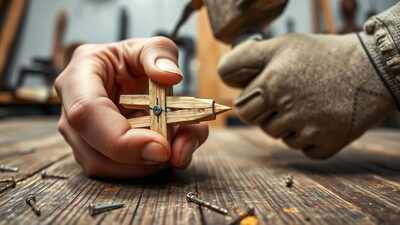
Everyone can relate to this situation. You are up on a ladder or down on the floor at the baseboard, trying to mount a heavy picture frame or steady some shaking base moulding. You grasp the minuscule nail in your fingers, take a deep breath, and hammer it. In no time at all, your wrist movement becomes the cause of a disaster.The jarring thud of steel hitting bone is a sound no DIY enthusiast ever wants to hear. While many people assume that bruised knuckles and smashed fingernails are just an inevitable part of home improvement, a growing number of clever makers are reaching into their laundry baskets for a solution.That little piece of wood can silently transform your experience of using a hammer, converting an anxiety-inducing task into a more efficient one. All you need to do is attach the nail to the clothespin, and you’ll have a new way to grip it. This will keep your fingers a safe distance away from the point of impact.The real cost of hitting your finger while hammeringIt may seem insignificant, but hammering injuries come with actual medical consequences. Finger injuries rank first among all types of injuries incurred by hammerers. For instance, the Phalangeal Fracture Secondary to Hammering One’s Finger is a medical paper found on Cureus that explains the severity of hammering injuries.The report describes how a routine task can result in severe fractures and lacerations that require professional medical intervention. When you hold a nail manually, your fingers are in the direct line of fire, and even a small lapse in concentration can lead to a trip to the emergency room.But perhaps what makes the phenomenon of missing even more interesting than the physics behind it is its mysterious origin. This issue was addressed in an article titled Hammering Does Not Fit Fitts’ Law that appeared in Frontiers in Computational Neuroscience. The scientists there examined the nature of our physical movements and our accuracy rate when performing repetitive motions with a hammer.It turns out that our accuracy depends on how hard we swing and the distance from us to the object that we are aiming for. When hammering by hand, one must find the balance between strength and pinpoint accuracy, thereby leaving no margin for errors. Add in a very simple tool like a clothespin, and you remove our humanity from the highly volatile situation.That simple change in behaviour proves to be the best solution in contrast to spending big money on expensive equipment. Even professionals may resort to the use of pneumatic nail guns, which, however, have their own pitfalls.However, according to a study featured in the American Journal of Industrial Medicine under the title Serious Injury and Fatality Investigations Involving Pneumatic Nail Guns, 1985-2012, advanced technology still has its dark side. The clothespin will do the job much better when it comes to working on most household jobs.
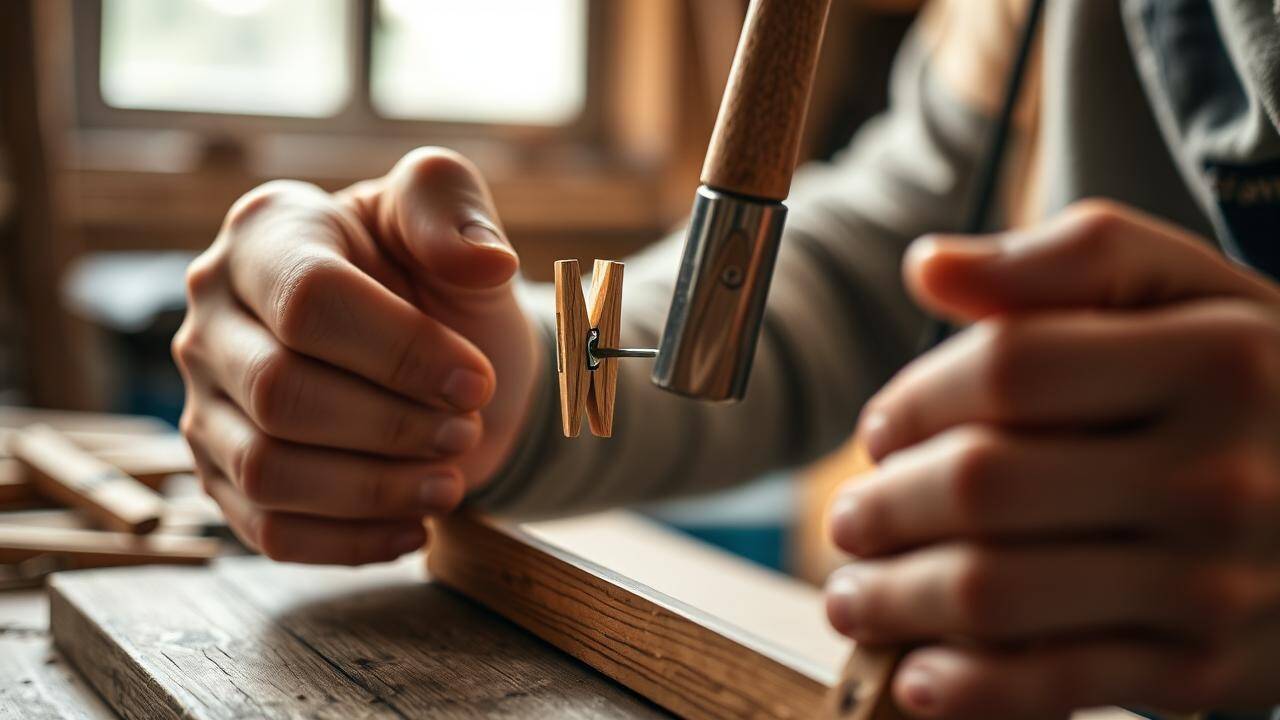
It’s a cost-effective and efficient solution, even outperforming expensive pneumatic nail guns for many household tasks, ensuring safer and more successful projects.
How to work with the clothespin trick to create a safe environmentFirst of all, select a reliable clothespin made of wood and featuring a strong spring mechanism. Insert the nail into the mouthpiece and hold it perpendicular to the clothespin. This way, you will create a good base for holding the tool with your hand being at least several inches from the nail itself. Then just place it along the edge or surface and tap a couple of times so that the nail settles. When it stays in place on its own, remove the clothespin and continue your work.This method is particularly a game-changer when working with small finishing nails or in tight corners where your hand might block your view of the target. It also helps preserve the finish of your project. Since you are not fumbling with the nail, you are less likely to leave “half moon” hammer marks on the wood or damage the surrounding paint. It is a win for your fingers and a win for the final look of your home.Practising such safe and easy methods can increase the beginner’s self-confidence. When demonstrating to a child or friend how to use tools for the very first time, one should start with using the clothespin nail holder to eliminate the primary concern. This way, a potentially frightening task is transformed into an enjoyable learning experience.In the end, the best DIY hacks are often the simplest, most sensible solutions that cost the least amount of money. Using an object found around the house, you can prevent unnecessary injuries while ensuring that your DIY projects go smoothly.The next time you reach into your toolbox, be sure to look for that clothespin hidden away. It will help protect your hands from injury, making hammering all the more enjoyable.