Washington — Senate Republicans unveiled a budget resolution on Tuesday to begin the process of funding immigration agencies under the Department of Homeland Security without help from Democrats.
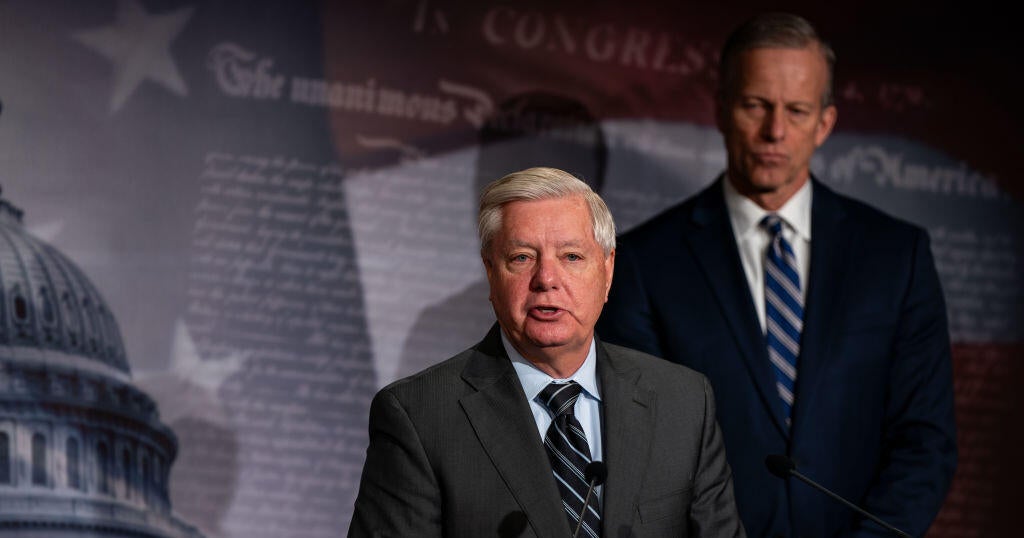
Republican Sen. Lindsey Graham of South Carolina, who leads the Senate Budget Committee, released the 58-page budget resolution, saying in a statement that Republicans are “moving forward — not backward — on rational immigration policies that secure our border.”
“Republicans are doing something that must be done quickly, and that our Democrat colleagues are trying to prevent us from doing. That something is simple: fully fund Border Patrol and ICE at a time of great threat to the United States,” Graham said.
The resolution authorizes the Senate Judiciary and Homeland Security committees to draft legislation to increase spending by up to $70 billion each, which would be used to fund Immigration and Customs Enforcement and parts of Customs and Border Protection. The final bill’s price tag is expected to be around $70 billion total, an aide to Senate Majority Leader John Thune said shortly after the resolution was released.
The measure is a key step toward approving the funding through the budget reconciliation process, which allows Senate Republicans to advance legislation with direct budgetary consequences without Democratic votes. Republicans are aiming to fund the agencies for 3.5 years, guaranteeing funds for immigration enforcement through the remainder of the Trump presidency.
For months, Democrats have opposed funding ICE and CBP, seeking reforms following two deadly shootings by federal agents in Minneapolis in January. But after talks failed to yield an agreement, Senate Republicans opted to fund the bulk of DHS through the appropriations process, while moving funding for immigration enforcement separately.
Senate Republicans are aiming to begin voting on the budget resolution as early as midweek, with a goal of moving quickly to get the final bill to the president’s desk by the June 1 deadline he set.
Thune told CBS News late last week that Republicans have been working on the budget resolution “for some time” and have done “a lot of the prep work” in the reconciliation process already. He pointed to “a number of conversations” with the Senate parliamentarian, the chamber’s rulekeeper who will determine whether any provision violates Senate rules.
Thune told reporters that the reconciliation plan isn’t the “ideal way to do this.”
“I really regret that the Democrats have forced us down this path, because in my view, the appropriations process is one of the, maybe not many, but at least few things that we ought to be able to do around here in a bipartisan way,” Thune said.
The plan to fund DHS’ immigration enforcement agencies has become central to the approval of funding for the department more broadly. Though the president has moved to temporarily pay DHS employees, the department has been shut down since Feb. 14. The Senate unanimously approved the plan to fund the bulk of DHS without ICE or CBP funding, but House Republicans have so far been unwilling to do the same.
Thune and House Speaker Mike Johnson announced an agreement earlier this month to fund most of DHS through appropriations and ICE and CBP through reconciliation. But some House Republicans have opposed moving forward until the reconciliation process is complete. And as a fight over the reauthorization of a key national security surveillance law plagues the lower chamber, moving forward with the DHS funding hasn’t appeared to be a top priority.
Johnson said last week that after the Senate acts, House Republicans will “do our part and fund those essential functions of the government, and then we’ll do the rest of Homeland Security.”
Thune said he’s hopeful that if the Senate “can show evidence and progress” and proceed to the bill this week, the House will move the funding for the rest of DHS forward. He said he and Johnson have spoken regularly, and the White House has been involved in the conversations.
“As we initiate this process, the budget resolution, followed up with a reconciliation bill, what it will include are all elements that I think as we have talked with the speaker and folks in the House of Representatives. They understand where we’re going,” Thune said.
A number of Republicans have called for additional priorities to be added to a reconciliation package, complicating its swift passage. On the possibility that House Republicans could ask for add-ons, Thune said “they could.”
“We have members who want other things,” Thune said. “I mean, I want other things. But obviously we have a specific mission and purpose here and that is to ensure that these important agencies of our government that have vital functions when it comes to our homeland and national security are funded.”