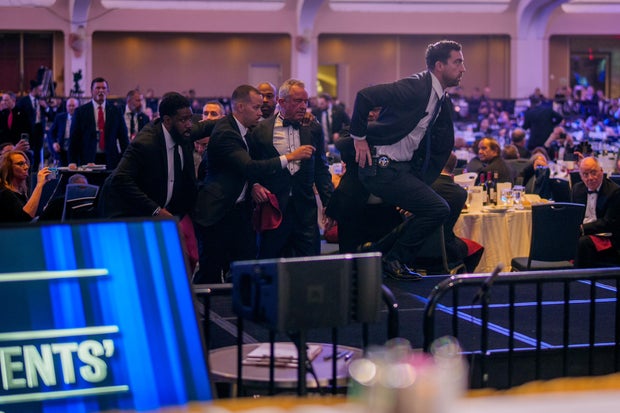
Robert F. Kennedy Jr. was amiably chatting with guests at the annual White House Correspondents’ Association dinner when shots rang out. Amid the ensuing chaos as dinner attendees took cover, Kennedy’s security detail rushed his table. One agent shielded Kennedy with his body while others hustled the secretary of health and human services out of the Washington Hilton ballroom and through a maze of service corridors to safety.
Andrew Harnik / Getty Images 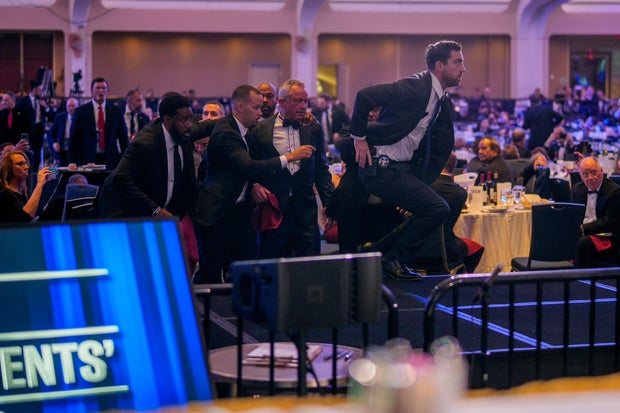
Kennedy’s father, Robert F. Kennedy, was assassinated in 1968 in a hotel ballroom in Los Angeles. The echoes of another period of political violence were unmistakable. For a country already on edge, the harrowing scene served as a bridge back to another volatile era when political assassinations and violence regularly shattered the American sense of order – the late 1960s and ’70s.
There’s much we still don’t know about the motives of alleged shooter Cole Tomas Allen, who traveled across the country by train, like some 19th century conspirator in an alleged plot to assassinate President Trump and other members of his Cabinet. Court documents suggest that Allen may fall into a pattern of disaffected men with political grievances, acting as lone wolves and looking to strike out against the very foundation of the state.
Bo Erickson / REUTERS 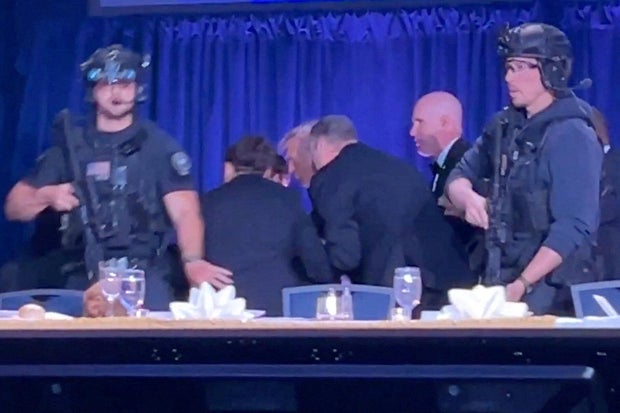
Trump has now been the target of three would-be assassins – a number believed to exceed the attempts on any previous president’s life. That fact alone should inspire at least a degree of national soul searching about the current spree of political violence. It raises the uncomfortable question of what happens when violence becomes normalized – and unstable people act out during unsettled times.
“Violence and politics have been central to the American experience since the birth of the republic,” said Steven Hahn, a New York University history professor whose latest book “Illiberal America” examines extremist impulses in U.S. history.
For historians, the 1960s and 1970s provide particularly eerie parallels to the present. Both eras were marked by bitter political divides and the unsettling feeling that America’s social fabric was being ripped apart. Following the twin traumas of Vietnam and Watergate, a widespread loss of faith in institutions took hold, creating a sense that government was unresponsive and politics was broken. Economic pain furthered the sense of a country losing its moorings. In the ’70s it was “stagflation” and the energy shock and a deeply unpopular war. Today it’s stubbornly persistent inflation, skyrocketing gas prices and a poorly explained war in Iran. Then and now, Americans sought solace in missions to the moon.
Owen Franken – Corbis, via Getty Images 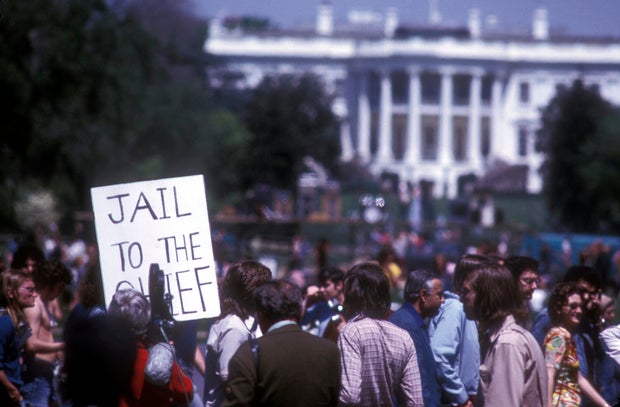
Many Americans today are experiencing a similar crisis of confidence, with little faith in government institutions, a deep alienation that has once again begun to curdle into violence.
“Throughout American history there have been periods where tensions became so great and as a nation, our focus on those tensions became so central that you have these bursts of violence against our political leaders,” said Julian Zelizer, a Princeton historian and co-author of the book “Fault Lines,” which argues that the hyperpartisanship in American politics today is rooted in the 1970s.
“We were living in one of those times in the late 60s till the mid ’70s and we are living through one of those today,” he said.
The commonalities are striking, but the differences are also instructive. In the ’60s and ’70s, the scale of violence was greater.
It began with the assassination of John F. Kennedy in 1963, followed by the killings of Malcolm X, Martin Luther King and Bobby Kennedy over the next five years.
Soon, the impulse toward violence was permeating through militant groups pushing all manner of causes, from race wars to radical environmentalism. During a particularly volatile time in the summer of 1975, there were two attempts on the life of President Gerald Ford.
AP photo 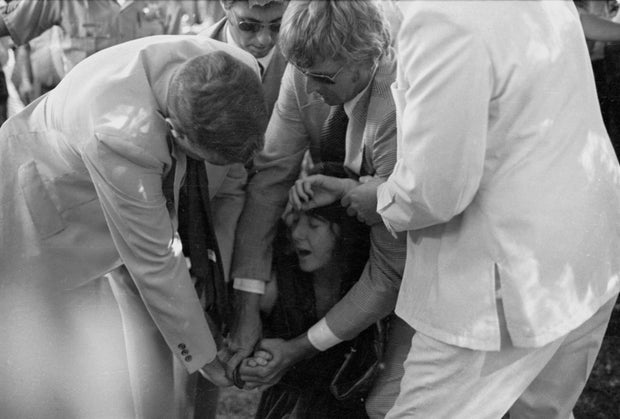
Lynette Squeaky Fromme, a member of both the Manson family and an extremist environmental group, stood within feet of Ford and fired her Colt .45, but the gun failed to discharge because there was no bullet in the chamber. Three weeks later, Sarah Jane Moore, who had ties to San Francisco’s militant underground groups, managed to fire a shot as Ford was leaving the St. Francis Hotel. The shot missed and a Marine in the crowd lunged at Moore, preventing her from getting off another round.
Between 1970 and 1971 alone, there were some 2,500 bombings in the country perpetrated by radical groups including the Weather Underground and the Symbionese Liberation Army, which was best known for kidnapping newspaper heiress Patricia Hearst.
Bettmann via Getty Images 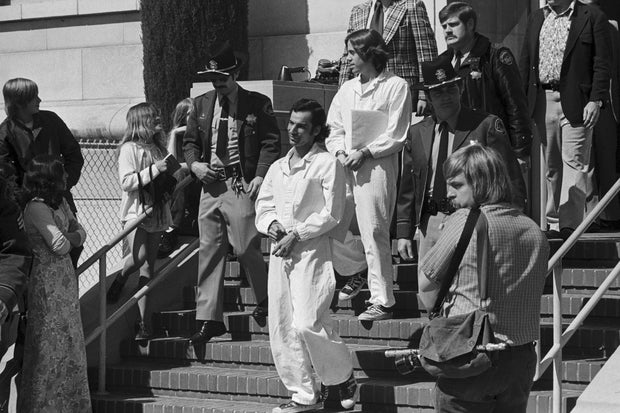
Between 1968 and 1972, there were more than 100 skyjackings carried out by groups like the Black Liberation Army and the Puerto Rican Nationalist Groups
Many of these acts of terrorism were not meant to be lethal, though some certainly were. The Weather Underground often struck empty buildings that they perceived as symbols of American injustice or oppression. Scholars of the period say most Americans saw the perpetrators as residing deep within the fringe of American culture. Political violence had not been normalized and nor had conspiratorial thinking been mainstreamed.
Bettmann/Corbis photo, via FBI 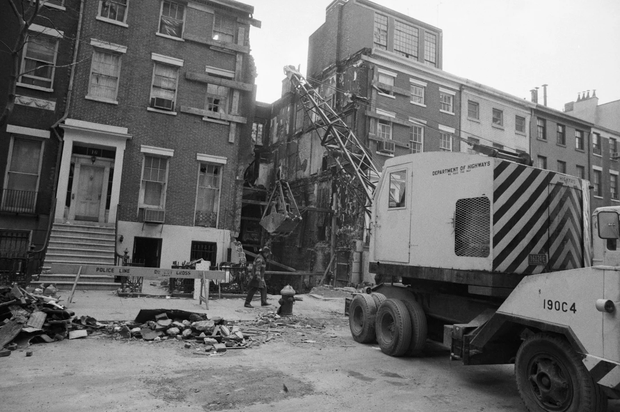
The political establishment was still trying to hold the country together.
“In the 70s, a majority of elected officials were still pushing against the divisions in the country,” said Zelizer. “Maybe it was hopeless, but there was still a mindset of a president trying to appeal to broad majorities, and most members of Congress didn’t appeal to voices on the American extremes.”
Today, by contrast, U.S. politics are in the grip of polarization that has fomented violent rhetoric from conservatives and liberals alike, as well as a growing ethos that our political opponents are enemies who must be destroyed.
That has been supercharged by an increasingly partisan information ecosystem and online culture that privileges anger over empathy and constructive dialogue. And while the vast majority of people carrying out acts of political violence today do not belong to organized extremist groups or subversive cells, they are often tied to online movements that affirm their extreme views and offer perceived permission structures that spur them to act out violently in the real world.
“Today we almost expect violence to be part of this highly polarized era,” said Zelizer. “When these events happen there isn’t even a national conversation anymore, there is no more water cooler. The violence has been normalized.”
One of the stated goals of the White House Correspondents’ Dinner is to gather Washington’s political class, lubricated by mediocre wine, to put aside the tribalism that defines the other 364 days of the year.
In a way, the intrusion of violence into the otherwise festive dinner did manage to galvanize a sense of comity between bitter political rivals. Amid the mayhem, they were able to see colleagues from both sides of the aisle who had themselves had been victimized by political violence, traumatized again.
There was House Majority Leader Steve Scalise, who was rushed out of the ballroom by his security detail, hampered a little by a heavy-gaited limp that was the direct result of a 2017 shooting at a practice for the annual congressional softball game. Scalise helped Democratic Rep. Jared Moskowitz, who himself was the target of an assassination plot in late 2024.
And then there was the wrenching sight of Erika Kirk whose husband, political activist and Trump confidant Charlie Kirk, was assassinated last year. She was escorted out of the ballroom in her floor-length evening gown and could be heard tearfully saying, “I just want to go home.”