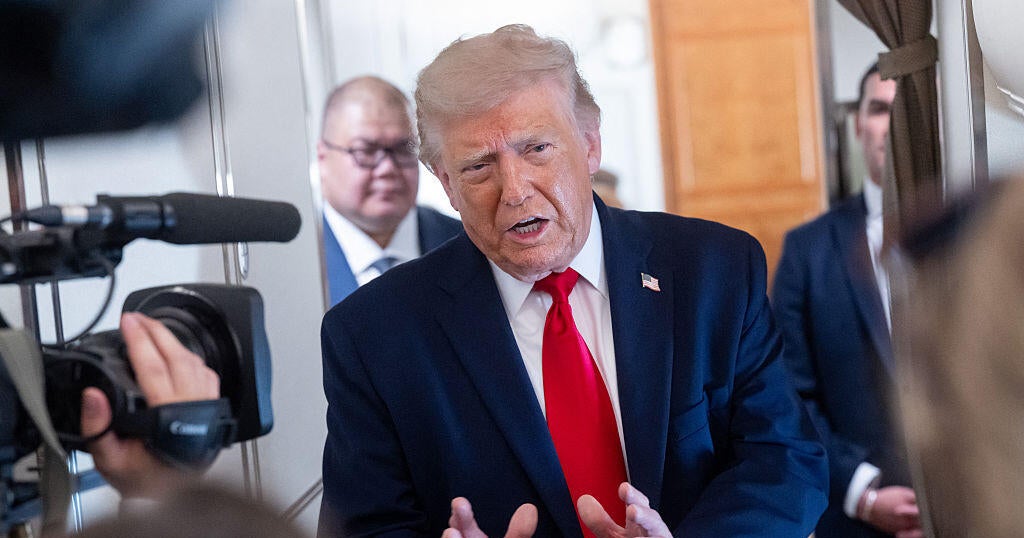
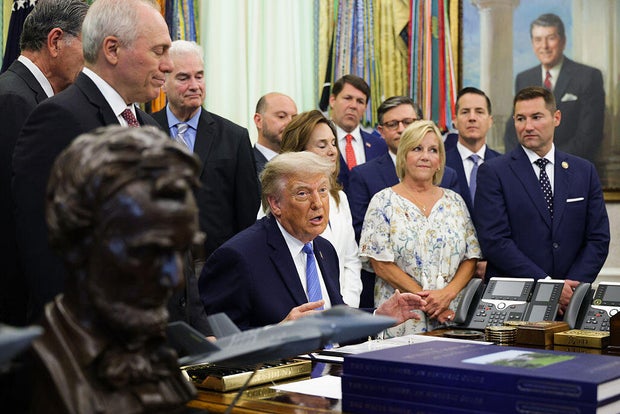
Washington — President Trump signed a bill into law to fund the Department of Homeland Security’s immigration enforcement agencies on Wednesday, bringing an end to a monthslong feud that exposed deep divisions on Capitol Hill.
“This morning I’m thrilled to sign the Secure America Act to immediately and fully fund the Department of Homeland Security through the end of my term, so we won’t have that to be talking about anymore,” the president said in the Oval Office, flanked by key members of Congress and his Cabinet.
The House approved the long-sought $70 billion funding package on Tuesday evening in a 214 to 212 vote, after the Senate passed the measure following an 18-hour marathon vote series late last week. The package funds Immigration and Customs Enforcement and parts of Customs and Border Protection through the end of the Trump administration. Democrats refused for months to fund the agencies without reforms.
“We’ll give the heroes of ICE and Border Patrol — and that’s what they are, they’re heroes, what they have to go through to keep us safe — the support and resources they need to defend our borders, protect our homeland and to keep America safe,” the president added, crediting House Speaker Mike Johnson for passing the bill with a slim majority in the House.
Alex Wong / Getty Images 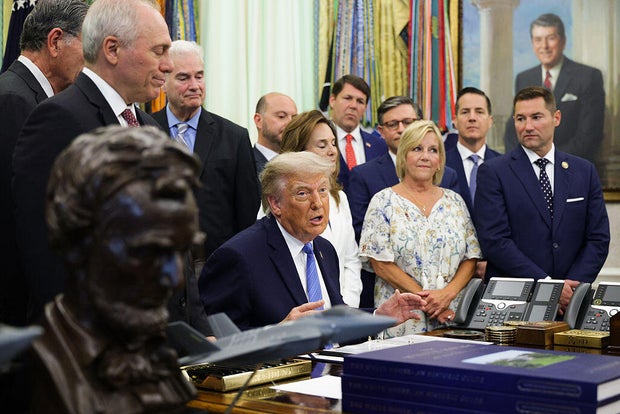
House Republican leaders were on hand for the signing, along with Senate Majority Whip John Barasso. Senate Majority Leader John Thune was not in the room.
Mr. Trump said the legislation “provides crucial funding for domestic law enforcement investigations and combating child exploitation, continuing our work to restore law and order across our nation.”
The immigration funding standoff began in January after two deadly shootings by federal agents in Minneapolis, which prompted Democrats to seek to rein in the immigration agencies. And although Democrats went back and forth with the White House and congressional Republicans over a possible compromise, the talks eventually broke down, leading the GOP to pursue an alternate path forward.
In a departure from the normal appropriations process, Republicans opted to fund the bulk of DHS with help from Democrats, while moving forward with funding for the department’s immigration enforcement agencies on their own. Using the budget reconciliation process, which allows the party in the majority to approve legislation with direct budgetary consequences without help from across the aisle, Senate Republicans pushed the package forward in recent months. But the process faced setbacks of its own.
A pair of developments in the administration threatened to derail the DHS funding. First, a dispute over funding related to the president’s White House East Wing renovation, where he plans to build a massive ballroom, divided Republicans. The initial reconciliation package included $1 billion for the Secret Service for security related to the complex, but intraparty pushback forced GOP leaders to strip it from the final package.
Just as the ballroom disagreement neared a resolution, the Trump administration raised a new hurdle. The Justice Department’s so-called “anti-weaponization” fund, which aimed to provide taxpayer-funded payouts to individuals who alleged the federal government had unlawfully targeted them, prompted intense opposition from congressional Republicans. Senate Democrats threatened to force Republicans to take difficult votes on the fund as part of the reconciliation process, so GOP leaders were forced to scrap plans to begin voting late last month.
After GOP leaders pushed the administration to drop the fund, acting Attorney General Todd Blanche testified before a House committee that the DOJ would not move forward with the payouts. The pledge was ultimately enough to quell GOP anxieties about the fund, and days later, despite hours of handwringing from a handful of Republicans, the Senate approved the package in a 52 to 47 vote.
On Wednesday, the president said Blanche has “tremendous support” in the Senate, after the president nominated him to officially become the attorney general.