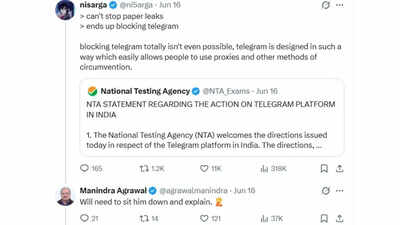
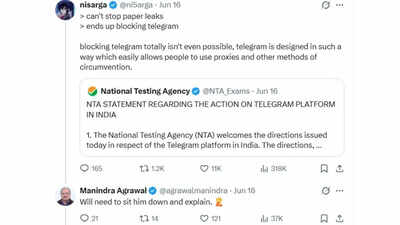
After questioning the government’s decision to restrict Telegram ahead of the NEET-UG 2026 re-examination, ethical hacker Nisarga Adhikary found himself on the receiving end of a public response from IIT Kanpur professor Manindra Agrawal.The exchange began after Adhikary reacted to the government’s move to temporarily restrict Telegram and disable its message-editing feature in India before the June 21 NEET-UG 2026 re-test.In a post on X, Adhikary wrote: “can’t stop paper leaks > ends up blocking telegram.”He followed it up by arguing that a complete block on Telegram would not work.“Blocking telegram totally isn’t even possible, telegram is designed in such a way which easily allows people to use proxies and other methods of circumvention,” he said.Adhikary’s remarks came in response to an NTA statement welcoming action against the platform. The agency said the measures were aimed at preventing the spread of fake paper leak claims and exam-related fraud ahead of the re-examination.Manindra Agrawal, a professor at IIT Kanpur, responded to Adhikary’s criticism with, “Will need to sit him down and explain.”“The problem with Telegram channel is not sharing of leaked paper, there are many other ways of doing it, rather that it can be used to spread fake news of leak that appears genuine. It was done by someone during JEE Advanced. It causes unnecessary confusion,” Agrawal wrote.The discussion continued when another user asked, “what about whatsapp”. Agrawal replied: “If you change a post in whatsapp, it shows when you edited it. So that is not a problem.“Adhikary replied saying Telegram showed it too. “Telegram client is open source and here’s the relevant code for the edit date/time function,” he said sharing the link.Adhikary recently joined IIT Kanpur’s cybersecurity innovation hub, C3iHub, as an Open-Source Intelligence (OSINT) and Threat Intelligence Engineer.The 19-year-old had recently made headlines after claiming to have identified security vulnerabilities in CBSE’s digital infrastructure. In a series of posts and a blog, he alleged that certain CBSE-linked answer sheets and question papers were publicly accessible due to cloud storage configuration issues.