A big storm is the great test of a forest. The wind comes howling through, and every tree has to answer it somehow. The mighty oak plants its feet and refuses to move, sure that its size will see it through. The slim bamboo does the opposite. It leans, sways, bows almost to the ground and lets the wind pass over it. When the storm finally blows itself out, guess which one is more likely to still be standing. This little proverb takes that scene and turns it into a lesson about people. Sometimes the one who bends is far stronger than the one who simply will not budge.
Proverb of the day
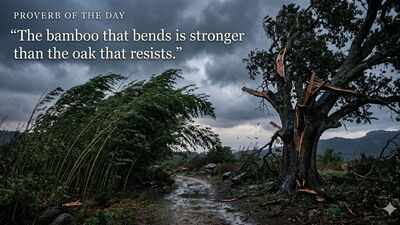
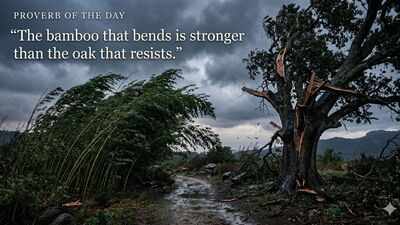
“The bamboo that bends is stronger than the oak that resists.”
Picture the storm for a moment
The whole proverb lives or dies on one image, so it helps to really see it.An oak is built to resist. Thick trunk, hard wood, deep stubborn roots. It meets force with force. That works beautifully, right up until a storm comes along that is bigger than the oak is strong. Then the very stiffness that made it feel safe becomes the thing that snaps it or rips it out of the ground.Bamboo plays a different game entirely. It is light, hollow and springy. When the wind hits, it does not argue. It bends right over, sometimes almost flat, and waits. The pressure slides off. And the second the wind drops, it whips back upright as if nothing happened. In heavy snow it does the same trick, bowing under the weight until the snow slides off and the bamboo springs back tall. It looks like the weaker plant. It usually outlasts the oak.
So what’s the lesson here
Swap the trees for people and the meaning clicks into place.The proverb is saying that flexibility is a form of strength, not a sign of weakness. The person who can adapt, listen, change their mind and roll with a setback tends to survive the storms of life better than the person who meets everything head on and refuses to give an inch. Rigid people look impressive. They also tend to crack under pressure that a more flexible person would simply absorb.It is not telling you to be a pushover. It is telling you that there is real power in knowing when to bend. The oak’s pride is exactly what kills it.This lands hard in a world that changes faster than ever. Jobs disappear, technology rewrites the rules every few years, and plans rarely survive contact with real life. The people who cope best are not usually the most stubborn ones. They are the ones who can take a hit, adjust, and keep going. Rigidity feels safe, but in a fast moving world it quietly becomes a liability.
Bending is not the same as caving in
This is the part the proverb can get wrong if you read it too quickly, so it is worth slowing down.Bending does not mean dropping your values the moment someone pushes. Look closely at bamboo and you notice something. The stalk bends like crazy, but the roots do not move. Underground, bamboo spreads a dense, stubborn network that grips the soil and refuses to let go. That is the real secret. It is flexible on top precisely because it is firmly anchored below.That is the version of the proverb worth keeping. Be soft about the small stuff, the plans, the methods, the ego, the need to win every argument. Stay rooted in the things that actually matter to you. A person with no flexibility snaps. But a person with no roots just gets blown wherever the wind feels like taking them. Neither one is strong. The trick is bending branches and steady roots at the same time.
How to bend like bamboo
The nice thing about this proverb is how practical it gets once you stop admiring it and start using it.
- When something hits that you cannot control, ask what you can adjust rather than bracing against the whole thing. Fighting every single gust just wears you out for no reward.
- Get clear on your roots, the few things you will not compromise on, and then hold everything else loosely. That clarity is what lets you bend without losing yourself.
- Treat a setback as a bend, not a break. The entire point of bamboo is that it springs back once the storm passes. Most bad days work the same way if you let them.
- Let go of the need to look tough. The oak seems like the strongest thing in the forest, all the way up to the moment it cracks.
Sayings cut from the same cloth
This idea is far too useful to belong to one culture, and it pops up again and again across history.
- “Bend but don’t break.” The plainest cousin of the whole proverb, and the easiest one to remember when things get hard.
- Aesop told it as a fable more than two thousand years ago. In it, the proud oak is torn out by a storm while the humble reeds bow low, let the wind pass and live to stand again.
- Lao Tzu and the old Taoist thinkers said much the same thing, that what is soft and yielding tends to outlast what is hard and rigid. To them, stiffness was closer to death and suppleness closer to life.
- There is even a Japanese saying behind the sport of judo, often translated as softness controlling hardness. It is why judo’s name literally means “the gentle way.”
Different lands, different centuries, one shared hunch. The thing that yields often outlasts the thing that resists.
Takeaway from the proverb
We tend to picture strength as something hard and immovable, the oak with its feet dug in. This proverb quietly disagrees. It says the truest strength might be the bamboo, bowing almost to the dirt and then rising again, unbroken, the moment the wind dies down.Storms are coming for all of us. Lost jobs, hard news, plans that fall apart overnight. The proverb does not promise you a way to stop the wind. Nobody gets that. What it offers is a better way to meet it. Stay rooted, stay flexible, and trust that bending today is often what lets you stand tall tomorrow.