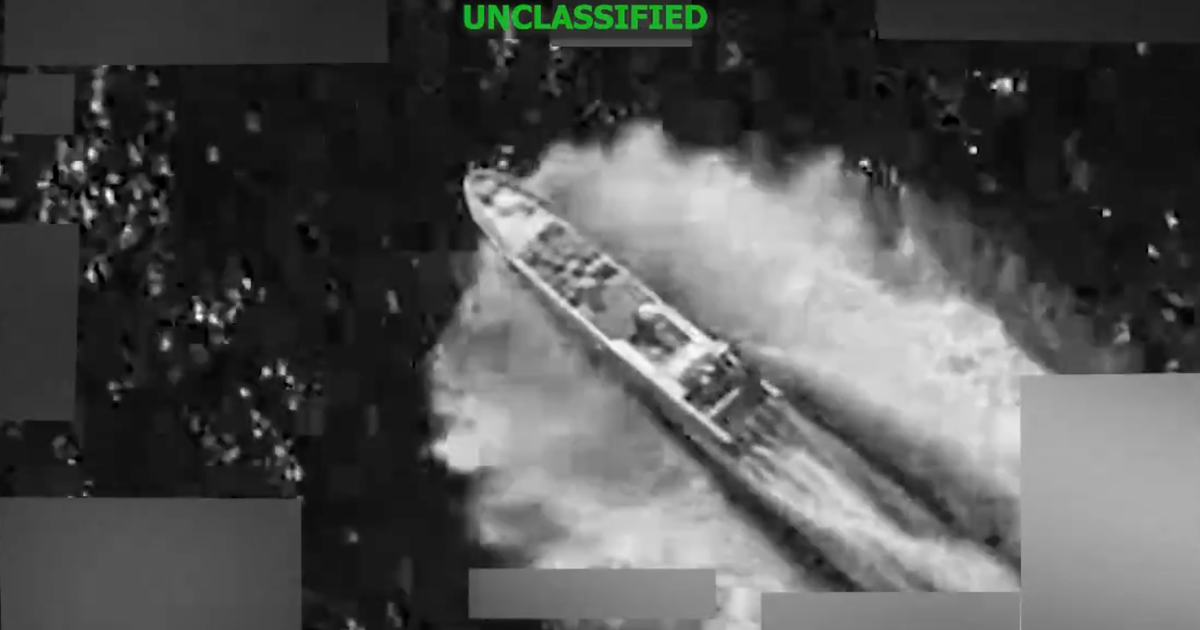
Washington — Hours after the U.S. launched its war against Iran in late February, President Trump laid out an aggressive list of war aims. He pledged to “destroy their missiles,” prevent the regime from rebuilding its nuclear program and set the stage for Iranians to “take over” the country’s government.
Now, as the Trump administration touts a newly signed memorandum of understanding to extend the U.S.-Iran ceasefire and jumpstart nuclear talks, the president has backed off some of those ambitions.
Mr. Trump told reporters this week it’s “OK” for Iran to keep some of its ballistic missiles. He said he isn’t in a hurry to recover Iran’s stockpile of highly enriched uranium, and isn’t vying for “regime change” in Iran. The memorandum of understanding also leaves most specifics on the fate of Iran’s nuclear program to be determined in additional negotiations over the next 60 days.
The president also shared some praise for Iran’s current leadership.
“We’re dealing with people that I think are very rational people, and they were nice to deal with,” Mr. Trump said of Iran’s current leadership during an event at the G7 summit in France on Tuesday, noting that some prior Iranian leaders were killed during the war. “They were strong people, smart people. … They’re not radicalized and they’re looking to help their country.”
Here’s what the president and top administration officials have said about key issues related to Iran, then and now:
Eliminating ballistic missiles
Trump, Feb. 28: “We’re going to destroy their missiles and raze their missile industry to the ground. It will be totally, again, obliterated.”
Secretary of State Marco Rubio, March 2: “I’m telling you what the objectives of this operation are. The objectives of this operation are to destroy their ballistic missile capability and make sure they can’t rebuild it, and make sure that they can’t hide behind that to have a nuclear program. That’s the objective of the mission.”
Trump, June 17: “If other countries have them, it’s a little bit unfair for [Iran] not to have some. A ballistic missile is not the same thing as what we’re talking about, when we talk nuclear. But if Saudi Arabia and Qatar, and they all have some — in relative proportion, I think it’s OK.”
Context: While Mr. Trump has said preventing Iran from acquiring a nuclear weapon is his primary goal, the administration and U.S. allies in the Middle East have long raised concerns about threats posed by Iran’s conventional military — especially its ballistic missiles, which can reach Israel and U.S. allies and military assets around the region. Throughout the war, U.S. forces heavily targeted Iran’s missile stockpile and missile factories.
The U.S.-Iran memorandum of understanding does not make any references to ballistic missiles, though Mr. Trump said Wednesday his administration will work on a “parallel effort” with Persian Gulf countries to address Iran’s conventional missiles and other “non-nuclear issues.”
Mr. Trump argued Wednesday that most of Iran’s missile stockpile was either destroyed or buried under rubble during the war. But he suggested he isn’t looking to fully eliminate Iran’s ballistic missiles.
He also appeared to mock some hawkish Trump supporters who want the country’s missile program to be more thoroughly decimated. “I have guys — I like some of these guys, but I don’t think they’re smart — ‘Sir, you shouldn’t let them have any missiles.’ I said: ‘Well, what am I going to do? Am I going to let Saudi Arabia have missiles, but they can’t have them?’ … It doesn’t work that way.”
“Nuclear dust”
Trump, April 17: “The USA will get all nuclear dust — you know what the nuclear dust is? That was that white, powdery substance created by our B2 bombers, those great B2 bombers, late one evening 7 months ago.”
Trump, April 26: “We have to take that nuclear dust. We’re going to take it, and that’s part of our negotiation with Iran. We don’t want them to have it.”
Trump, June 16: “What’s happening is that at an appropriate time — there’s no rush at all. We have cameras from space on it. We know everybody that goes there, which is, like, nobody. The B2 bombers hit it. The entire mountain collapsed inside it. It’s a very tough excavation. Nobody else can do it, but us, and probably China. They have the equipment, we have the equipment. We’re in no rush, but we get it. And when we get it, we’ll destroy it.”
Context: In the years leading up to the war, Iran amassed a stockpile of 60% enriched uranium, which is just a short step away from weapons-grade material. Much of that material was held in a handful of subterranean facilities that were bombed by the U.S. last year, making it difficult to access.
During this year’s war, the Trump administration strategized on ways to recover the uranium, which the president calls “nuclear dust.” An operation to dig through the rubble and take the material would have been among the most challenging and risky special operations missions in U.S. history, experts say.
In the memorandum of understanding, the U.S. and Iran “agreed to resolve the disposition of stockpiled enriched material” in their talks over the next 60 days. The “minimum methodology” is “down-blending” the uranium to a lower level of purity onsite, under the International Atomic Energy Agency’s supervision.
But Mr. Trump suggested this week taking the material is not an urgent task, expressing doubt that Iran can recover it. He said Wednesday “we’d like to get it psychologically, but nobody’s touching it.”
Uranium enrichment
Trump, Feb. 27: “They want to enrich a little bit. You don’t have to enrich when you have that much oil. … I say, no enrichment. Not 20%, 30%. They always want 20%, 30%. … They want it for civil. I think it’s uncivil.”
Trump, June 14: The final deal must permanently ensure that Iran “can only enrich for nonmilitary purposes” and “can never go beyond a certain amount,” the president said in an interview with The New York Times in which he said he wants a suspension on uranium enrichment for 15 or 20 years.
Trump, June 17: “I’ve said to them always: ‘You have probably the third-largest oil reserves in the world. What the hell do you need nuclear for?’ … It is a little hard, though, when you say that somebody wants it, other people have it, other adjoining states have it, and you’re not letting them have it for purposes of electricity and things like that. It’s always a little tough. You have to use a little common sense.”
Vice President JD Vance, June 18: “The Obama nuclear deal allowed enrichment. Ours will not.”
Context: Iran has long refused to fully give up its uranium enrichment program. Iranian officials insist the program is intended for peaceful purposes, and as recently as last year, U.S. intelligence agencies found Iran was not actively building a nuclear weapon, though Iran has enriched uranium in recent years to levels well beyond what’s necessary for most non-military purposes.
The 2015 nuclear deal inked by the Obama administration allowed Iran to keep enriching uranium to 3.67%, significantly below the 90% used for bombs, with limits on the size of Iran’s stockpile and the number and types of centrifuges Iran could operate. That structure drew criticism at the time, and Mr. Trump withdrew the U.S. from the deal during his first term in office.
Prior to the outbreak of war, Mr. Trump said he wanted Iran to agree to “no enrichment.”
The U.S.-Iran memorandum of understanding leaves specifics on uranium enrichment for later, saying only that the two countries “agreed to discuss the issue of enrichment and other mutually agreed matters related to the Islamic Republic of Iran’s nuclear needs.” It’s unclear what a final deal could look like. Mr. Trump suggested this week it could be “hard” to get Iran to fully give up its nuclear program, but Vance suggested the president’s red line of no enrichment is still in place.
Regime change
Trump, addressing the Iranian people in a video on Truth Social on Feb. 28: “Take over your government. It will be yours to take. This will be, probably, your only chance for generations.”
Trump, March 29: “We’ve had regime change, if you look already, because the one regime was decimated, destroyed, they’re all dead. The next regime is mostly dead, and the third regime, we’re dealing with different people than anybody’s dealt with before. It’s a whole different group of people. So I would consider that regime change.”
Trump, June 16: “You talk about regime change. I never cared about regime change.”
Context: In the war’s opening hours, Mr. Trump explicitly framed it as an opportunity for the Iranian people to overthrow the Islamic Republic, which has governed Iran since 1979. After Supreme Leader Ayatollah Ali Khamenei was killed in strikes, Mr. Trump said he wanted a role in picking Iran’s next leader, and was “disappointed” by the decision to elevate Khamenei’s son to the post of supreme leader.
More recently, as the Iranian regime has remained in place, Mr. Trump offered a slightly different view, arguing the killing of prior Iranian leaders was effectively a form of “regime change.”
Frozen assets and sanctions relief
Trump, May 27: “No, we’re not talking about any easing of sanctions or giving money. No sanctions, no money, no nothing.”
Trump, June 17: “It’s not our money, it’s their money. And we froze it at a certain point in time, I guess we’re going to have to give it back.”
Context: A key issue for Iran is the removal — or suspension — of intense U.S. sanctions that have hobbled Iran’s economy and frozen its assets, many of which date back to the “maximum pressure” campaign in Mr. Trump’s first term or even earlier. The Obama-era nuclear deal lifted sanctions in exchange for limits on Iran’s nuclear program, an arrangement Mr. Trump argued in 2018 gave Iran “many billions of dollars.”
This week’s memorandum of understanding says the U.S. will lift “all types of sanctions” against Iran on an “agreed-upon schedule as part of the final deal.” The Trump administration has said no sanctions will be removed or assets unfrozen unless Iran demonstrates compliance.