India is among the world’s largest economies, with its GDP nearly doubling in the last 10 years. Yet, when it comes to the strength of its passport, it doesn’t rank even among the top 50. Neither does China for that matter. The United States of America – the world’s largest economy – also sits at tenth rank with over 35 countries boasting of a more powerful passport than the US.According to Henley Passport Index rankings, India’s trajectory illustrates how challenging it can be to move significantly up the index in an increasingly competitive global mobility landscape.So, why are the passport rankings of some of the world’s top economies not among the best. And why does India, sit at a rank much lower than all the other top economies in the world? What factors decide the ranks and strengths of passports globally and what can India do to improve its rankings? We take a look:
India’s passport rankings: The trend
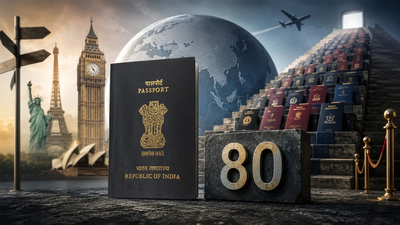
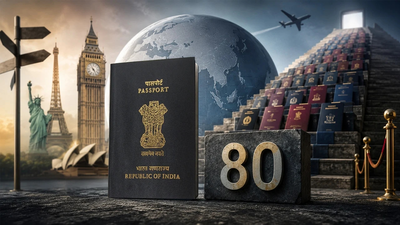
India’s passport ranking has fluctuated considerably over the past two decades, reflecting changing visa policies, diplomatic agreements and global mobility trends.According to the latest edition of the Henley Passport Index 2026, India ranks 80th globally, with Indian passport holders enjoying visa-free, visa-on-arrival or electronic travel authorisation (ETA) access to dozens of destinations worldwide.The current position marks an improvement from 85th place in 2025, but India remains far below the world’s most powerful passports.According to the latest ranking, Indian passport holders can travel to 56 countries without a visa, while a visa is required for 170 countries. Most of these visa-free countries are African and Southeast nations.
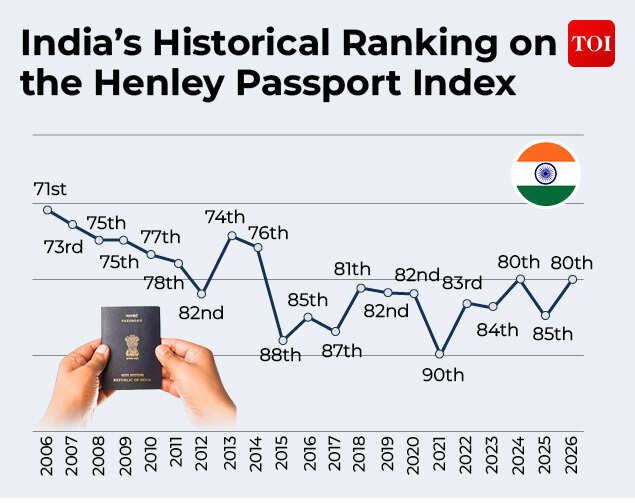
India’s historical ranking
Historical Henley Passport Index data shows that India’s ranking has moved unevenly rather than following a steady upward trajectory.In 2006, India stood at the 71st position. The ranking gradually slipped over the following years, reaching 82nd in 2012. A brief recovery followed, but India again witnessed a decline during the middle of the decade, falling to 88th position in 2015, one of its weakest performances in the index’s history.The passport’s standing improved after that, climbing to 81st in 2018 before slipping again during the Covid-19 years.India reached its highest level of travel freedom in 2024, when holders could access 62 destinations without obtaining a visa in advance.The broader trend suggests that while India has recovered from the sharp decline seen during the pandemic period, its passport mobility has largely remained within the 70-90 rank range over the past two decades.Dominic Volek, Group Head of Private Clients at Henley & Partners says that over the last ten years, India recorded a net gain of four destinations. By comparison, many of the passports at the top of the index added between 10 and 20 destinations over the same period.
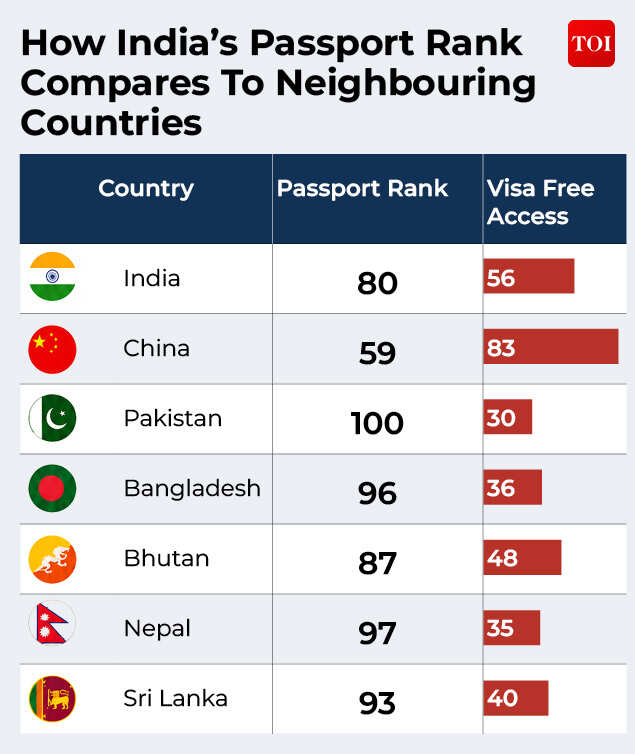
How India’s passport rank compares to neighbouring countries
India has made travel to the country more accessible through an extensive eVisa programme, but visa-free entry remains limited for many nationalities.While India’s passport has recorded modest improvements in both ranking and visa-free access over the last decade, it has not experienced the rapid gains seen among some of the strongest-performing passports on the index.
What factors decide passport rankings?
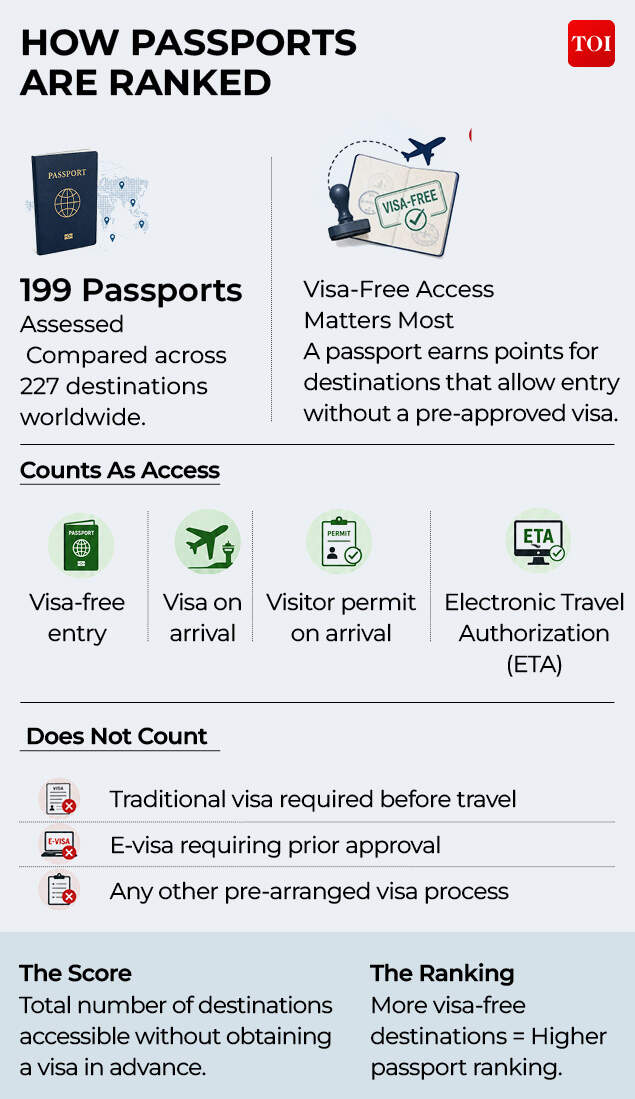
A key reason is that passport rankings are relative rather than absolute. Even if India secures visa-free access to additional countries, its ranking can remain unchanged or even decline if other countries expand their mobility faster.Passport rankings are often misunderstood as a measure of a country’s economic strength or geopolitical influence. In reality, the Henley Passport Index focuses on a much narrower metric: travel freedom.According to Henley & Partners, which publishes the index, rankings are based on data from the International Air Transport Association, supplemented by the firm’s own research and continuous monitoring of global visa policies.The index currently evaluates 199 passports across 227 travel destinations.Each passport receives a score based on the number of destinations its holder can enter without obtaining a traditional visa before departure.A destination receives a score of one point if travellers can enter visa-free, obtain a visa on arrival, receive a visitor’s permit at the border, or secure an electronic travel authorisation.By contrast, destinations requiring a traditional visa or a government-approved electronic visa before travel receive zero points.
How passports are ranked
One important feature of the methodology is the distinction between ETAs and e-visas.Henley treats ETAs as visa-free access because they generally involve quick online authorisation and minimal documentation. E-visas, however, are treated as visa requirements because travellers must obtain formal approval before departure.The index also makes several assumptions. It evaluates ordinary passport holders travelling for short-term tourism or business purposes and assumes travellers meet standard entry conditions such as passport validity, proof of funds and other routine requirements.Because rankings are driven entirely by visa policies, they can change quickly.A new visa-waiver agreement, tightened border controls or geopolitical developments can alter a country’s position even without any change in the passport itself.For this reason, passport rankings are often viewed as a reflection of a country’s diplomatic relationships, reciprocal visa arrangements, security perceptions and international trust, rather than simply its economic size or military power.According to Dominic Volek, many of the changes affecting India’s score in recent years have been driven by broader visa policy adjustments by destination countries, such as the reclassification of visa-on-arrival arrangements to eVisa systems.“These types of policy changes often affect multiple passports simultaneously and are not typically directed at any single nationality. There have also been instances where countries have specifically expanded access for Indian nationals as part of broader tourism and economic initiatives. Recent examples include the Philippines and Malaysia, both of which have introduced or extended visa-free entry arrangements for Indian travellers,” Dominic Volek tells TOI.Sebin Jinny, Partner, Vialto Partners explains that passport strength is influenced less by total GDP and more by factors such as per-capita income, migration risk, document security, and diplomatic relationships.India has improved its position on global passport rankings, yet it still trails several smaller economies because average income levels remain significantly lower than those in many developed countries, he tells TOI.
How India compares to other world economies
Among the world’s ten largest economies by GDP — the United States, China, Germany, Japan, India, the United Kingdom, France, Italy, Canada, and Brazil — several distinct trends have emerged over the past decade, says Dominic Volek.
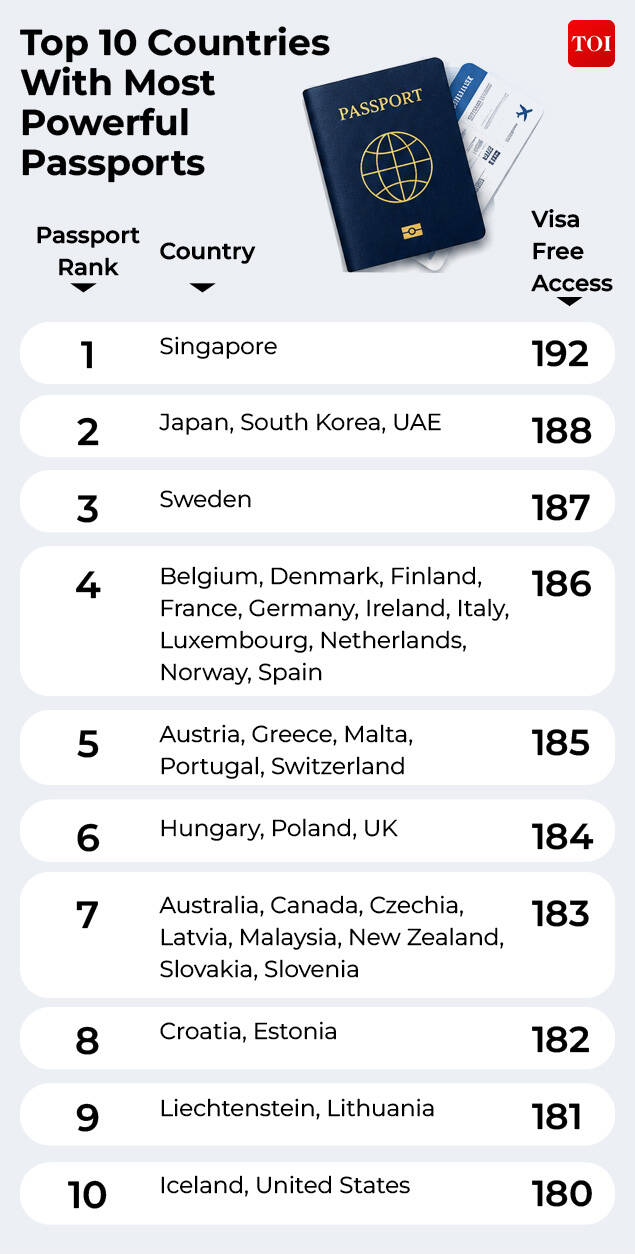
Top 10 countries with most powerful passports
He highlights some interesting points:
- The United States and the United Kingdom, both of which previously held the top position on the Henley Passport Index, have gradually slipped down the rankings.
- The US currently sits in 10th place and the UK in 6th, largely because other countries have expanded their visa-free access more rapidly.
- Canada has also experienced a modest decline in relative ranking for similar reasons.
- By contrast, the major European economies and Japan have consistently remained among the strongest passports globally.
- Germany, France, Italy, and Japan have all spent the last decade near the top of the index, with only limited fluctuations in their positions.
- Brazil has steadily strengthened its passport, improving from 21st to 16th place since 2016 after gaining access to an additional 16 destinations. It continues to move closer to the top tier of the ranking.
- China has recorded one of the most significant improvements among major economies. Starting from a position similar to India’s a decade ago, it has climbed substantially through a combination of diplomatic engagement and a more open approach to international mobility.
- India, meanwhile, has experienced relatively stable performance over the same period, with modest gains in both access and ranking.
The United Arab Emirates represents the most dramatic example of upward mobility, gaining access to 66 additional destinations and rising from 38th place in 2016 to 2nd place today.Yet another example of increasing passport strength is China. During the same period, the Chinese passport has risen from 87th to 59th place on the Henley Passport Index as more destinations have extended visa-free access to Chinese citizens.
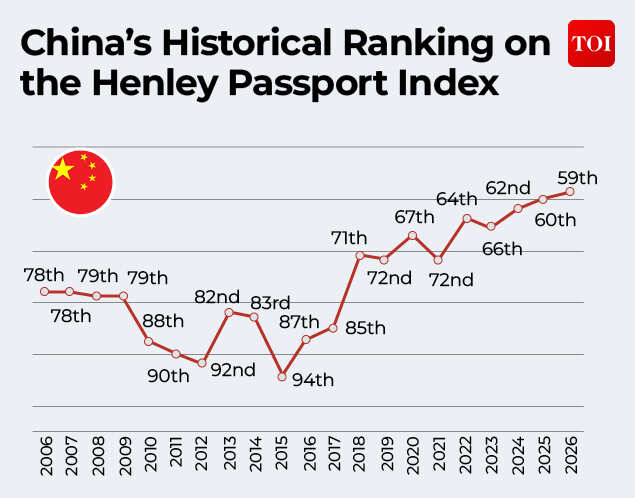
China’s ranking
As the Henley & Partners’ expert notes: Over the last decade, it has significantly expanded visa-free access for foreign nationals, including through a series of unilateral visa-waiver programmes.
What India can do to improve rankings
Experts say diplomatic engagements and internal processes of security will go a long way in building trust. Reciprocal agreements also work towards obtaining visa-free access.Dominic Volek of Henley & Partners said this can typically be done through sustained diplomatic engagement and the negotiation of reciprocal visa-waiver agreements.He also points out that some passports benefit from structural advantages.For example, membership of the Schengen Area provides European countries with extensive mutual travel access, automatically contributing significantly to their visa-free scores.Beyond these regional arrangements, however, most gains are achieved through bilateral agreements and broader diplomatic initiatives.“Reciprocity can also play an important role. Countries that expand entry privileges for foreign visitors may find that other states become more willing to offer similar treatment in return,” he says.Passport security and the reliability of identity documentation also influence international trust, say experts. Vialto Partners’ Sebin Jinny says India’s rollout of biometric e-passports and digital visa systems is a positive step that should strengthen confidence over time, although such trust is typically built gradually.“Improving global mobility requires a strategic shift. Despite India’s growth, this has not fully translated into confidence about outbound travellers. Strengthening income stability, reducing informality, and improving employment signals can gradually reshape these perceptions,” he adds.India’s progress is real, but gradual. “Beyond diplomatic efforts, India will need to strengthen internal systems and processes,” Sebin Jenny tells TOI.“India has the economic weight, diaspora relationships, and growing diplomatic footprint to achieve this. The question is whether passport strength becomes an explicit national priority—or remains a byproduct of other decisions,” he concludes.