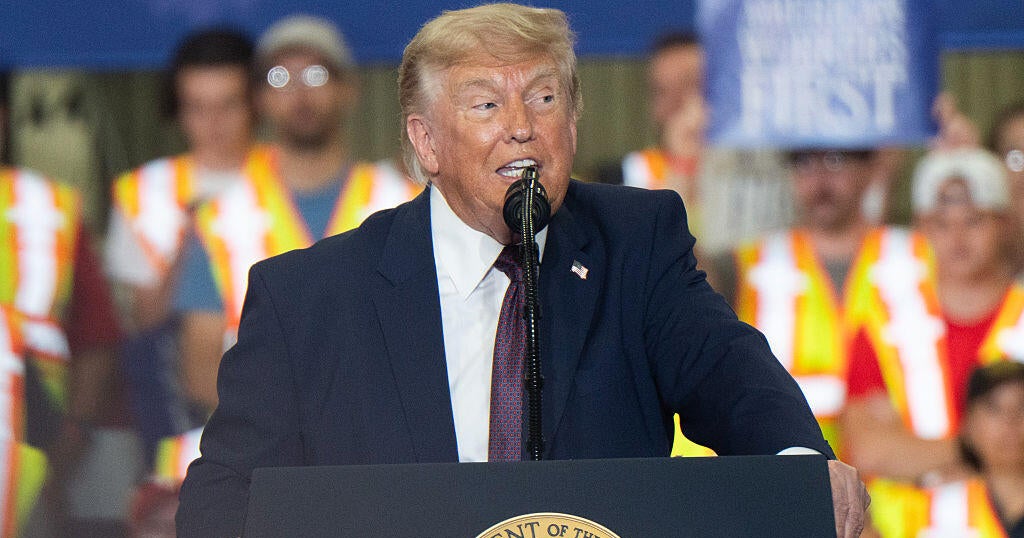
Washington — President Trump canceled a planned signing ceremony on Wednesday for a housing affordability bill that passed Congress by wide bipartisan margins, saying he will not sign the legislation into law until lawmakers pass an elections bill known as the SAVE America Act.
Mr. Trump was set to sign the bill, known as the 21st Century ROAD to Housing Act, in an event at the Capitol. The legislation, the most comprehensive housing legislation in decades, aims to increase housing supply and bring down costs, including by limiting institutional investors from purchasing certain single-family homes.
“Today’s Housing News Conference and Signing is hereby cancelled until such time as we pass the desperately needed SAVE AMERICA ACT, which I consider to be a National Emergency,” he wrote. “Thank you for your attention to this matter! President DJT”
The president is set to meet with Republican senators while on the Hill to discuss the SAVE America Act. He and his allies in Congress have demanded the Senate take up the measure, but Republican leaders in the upper chamber have repeatedly said they do not have the votes to approve it or change Senate rules to push it through. It would impose strict new limits on registering to vote and casting a ballot.
Mr. Trump’s refusal to sign the housing bill denies Republican lawmakers a key accomplishment heading into the midterm elections, where affordability is top of mind for voters.
In an earlier post, the president downplayed the significance of the housing bill in comparison to the SAVE America Act.
“The Elizabeth ‘Pocahontas’ Warren centric housing bill, which is of minor importance compared to lower interest rates, and even FISA, pales in comparison to passing THE SAVE AMERICA ACT,” he wrote, referring to the Massachusetts Democratic senator who has been one of the main proponents of the bill.
The House approved the housing bill Tuesday evening by a wide bipartisan margin after the Senate passed the measure a day earlier. Its passage through both chambers came after months of back-and-forth between the two chambers.
What the housing bill does
Among its more than 45 provisions, the bill includes provisions aimed at increasing development of affordable housing by removing regulatory barriers and streamlining environmental reviews. It also:
- Launches a pilot program to help local governments convert vacant commercial buildings into affordable housing;
- Unlocks more federal funding for the construction of factory-built homes;
- Eliminates a rule that requires homes to be built on a chassis, a steel framework used to transport them;
- Creates an innovation fund for communities increasing housing supply and supports housing opportunities for veterans;
- Limits the purchases of single-family homes by institutional investors.
Supporters say the institutional investor limits will cut competition and benefit homebuyers. The restrictions apply to existing single-family homes, not new construction, a carveout that preserves incentives for financial firms to invest in new housing construction, a Senate staffer previously told CBS News.
As of 2025, larger institutional investors — those that own more than 1,000 homes — owned a combined 500,000 properties, accounting for 0.34% of U.S. housing stock and roughly 3% of the total single-family rental supply, according to analysts with BofA Global Research.
Yet such investors are a much larger presence in some cities. In Jacksonville, Florida, for example, investors own more than 20% of single-family rental homes, according to a 2026 U.S. Government Accountability Office analysis. Between 2018 and 2024, Dallas and Phoenix each added at least 16,000 investor-owned homes, up 177% and 114%, respectively, over that period.
Institutional investors “don’t own a large percentage of all the single-family homes in the United States, but it’s concentrated in certain communities throughout the country, and that’s the concern,” said Dennis Shea, executive vice president at the Bipartisan Policy Center.
The legislation’s passage represented a rare moment of bipartisan achievement in a Congress that has been marked by obstruction and a series of stalemates. Lawmakers have feuded over some of their most basic responsibilities, like funding the government, while party-line legislation has been the focus of the previous 18 months in narrow GOP majorities.
The bill’s passage was even more striking in an election year, when divisions are generally more pronounced.
“The fact that Democrats and Republicans were able to come together on the ROAD to Housing, at a time of such division, shows just how dire America’s housing crisis is today,” Senate Minority Leader Chuck Schumer said as the bill advanced in recent days. “The ROAD to Housing is a crucial first step toward ending the affordability crisis.”