US Treasury Secretary Scott Bessent’s latest warning of additional tariffs under Section 301 comes at a time when US Trade Representative Jamieson Greer was in India this week.Greer met Commerce minister Piyush Goyal and held two-day talks to finalize the first phase of the India-US bilateral trade agreement (BTA). While both sides have indicated that they are ‘very close’ to finalising a trade deal, India has held firm on looking to attain an advantage compared to other countries.The latest statements by Bessent indicate that the Donald Trump administration is looking at alternative ways to impose tariffs on its trading partners since the US Supreme Court has ruled reciprocal tariffs as illegal.
What US has said on more tariffs
Bessent said tariff rates could revert to their earlier levels if the ongoing Section 301 investigations by the Office of the US Trade Representative (USTR) lead to the imposition of new duties.“Right now, we have something called Section 122 tariffs, which is a 10% global tariff. Currently, USTR ambassador Jamieson Greer, is doing studies for Section 301. And if those studies are successful… then the tariff rates are going to go back to exactly where they were,” Bessent said.Bessent made it clear that President Donald Trump had used reciprocal tariffs last year as a tool to bring trading partners to the negotiating table and secure trade agreements. He indicated that the outcomes of the Section 301 investigations are intended to serve a similar purpose.
What is Section 301?
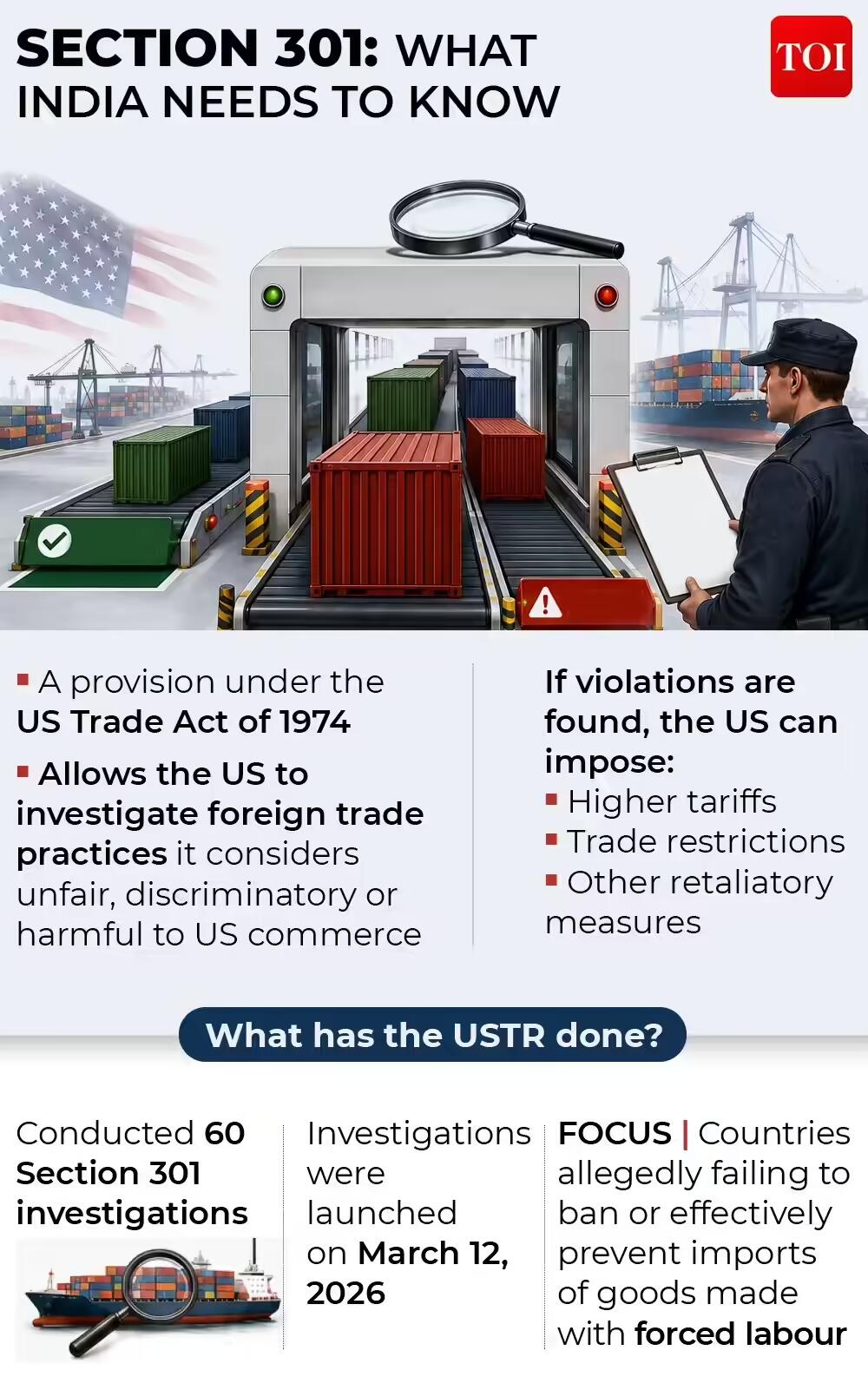
The Section 301 investigation initiated by the United States in March 2026 has remained a key element in the ongoing trade negotiations between India and the US. Section 301 of the US Trade Act of 1974 empowers the Office of the United States Trade Representative (USTR) to investigate the trade policies and practices of foreign governments. Its purpose is to determine whether such practices unfairly disadvantage US trade interests.
Section 301 explained
India and the United States had announced a trade pact in February this year under which tariffs on Indian exports were reduced from 50% to 18%. Before the agreement could be formally finalised, however, the US Supreme Court ruled that the reciprocal tariffs introduced by the Donald Trump administration were unlawful. Shortly thereafter, President Trump imposed a universal 10% tariff, which is scheduled to lapse next month. Under US law, Section 122 tariffs can remain in force for a maximum of 150 days, with the current measures set to expire on July 24. In its preliminary findings, the USTR has proposed an additional 12.5% tariff on imports from India and more than 50 other countries, citing their alleged failure to curb imports linked to forced labour. The findings of a separate Section 301 investigation into structural excess capacity involving 15 countries, including India, are still awaited.India is among the 54 economies identified by the USTR as having failed to establish and effectively enforce a prohibition on forced labour imports. Under the current proposal, Indian exports would face an additional tariff of 12.5%. At present, the proposed duties have not been finalised. Countries wishing to challenge the findings can submit requests to participate in the hearings, along with summaries of their testimony, by June 22, 2026. Written submissions will be accepted until July 6, while the hearings are scheduled to begin on July 7.A final determination is expected in July, around the time the existing 10% Section 122 tariffs are due to expire. Trade experts have cautioned that if approved, the new tariffs could come into effect immediately after the hearing process concludes.
India-US trade deal
Trade specialists view the Section 301 investigations as part of a broader negotiating strategy by the United States. They note that India has already raised concerns over the investigations during the ongoing trade discussions with Washington.As India and the United States continue discussions on a bilateral trade agreement, Commerce and Industry Minister Piyush Goyal has reiterated that any final deal must preserve India’s competitive advantage.“We had negotiated that deal on bringing down 50% tariff to 18%. The whole deal was centred around the competitive advantage over our neighbours and other competing countries. We were lower than all our neighbouring countries, all the Asean countries, other than Singapore. That is why the deal was attractive,” he said.“We have to have some reason to be able to enter into force the agreement that we have and to ensure that we get a competitive advantage over countries in the same stage of development or same cost structures as India, whether its Vietnam, Thailand, the Philippines, Indonesia, Malaysia, China apart from Bangladesh, Sri Lanka and all our neighbours. Until that framework of getting that competitive advantage can be finalised, we can’t enter into force a US deal. That’s broadly the discussion,” Goyal said in London.