
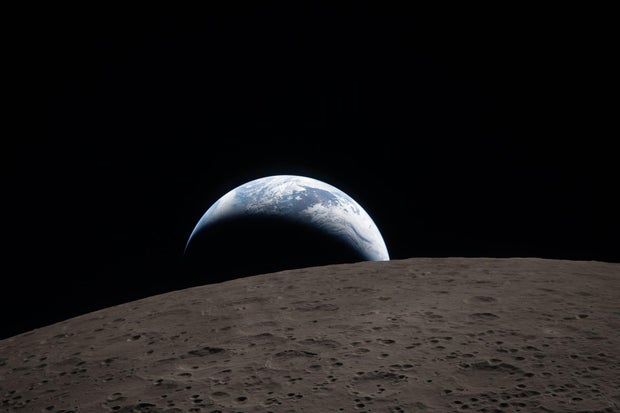
Stunning photos taken by the Artemis II crew were released on Tuesday, showing spectacular views from the far side of the moon and an eclipse in space.
One image from NASA showed “Earthset” — the Earth dipping behind the moon. Part of the Earth is seen in darkness, while Australia and Oceania are visible on the planet’s surface. Details of the moon appear in the photo’s foreground.
“Humanity, from the other side,” the White House said about the image.
NASA 
The image was captured through the window of the Orion spacecraft on Monday evening as the Artemis II crew conducted a flyby of the moon — becoming the first humans to see some parts of the moon’s far side with the naked eye and traveling farther from Earth than any other humans in history.
Another stunning photo showed the moon eclipsing the sun. The eclipse was not visible from Earth, only to the crew aboard the spacecraft, and the astronauts needed to wear eclipse glasses to protect their eyes until the moon completely covered the sun.
“From the crew’s perspective, the Moon appears large enough to completely block the Sun, creating nearly 54 minutes of totality and extending the view far beyond what is possible from Earth,” NASA said about the image.
NASA 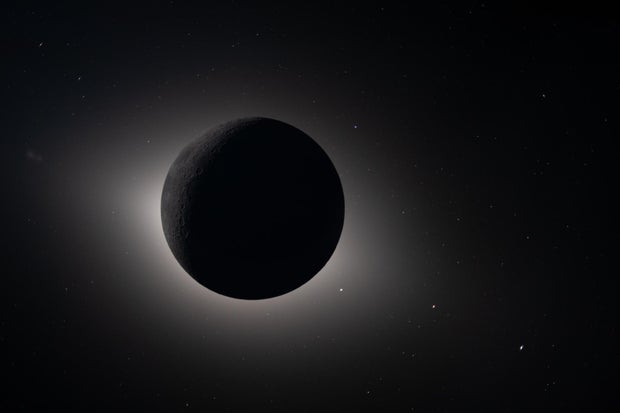
Astronaut Victor Glover said the sun’s corona remained visible and bright during the eclipse, creating “a halo almost around the entire moon.” He said the photos of the eclipse didn’t do the display justice.
“It just looks unreal. You can see the surface of the moon against the Earthshine. … You can actually see a majority of the moon. It is the strangest looking thing that you can see so much on the surface,” he said on Monday evening.
He told NASA that he was “really glad” the mission launched in time to see the eclipse, which lasted about an hour.
“Because humans probably have not evolved to see what we’re seeing,” he said. “It is truly hard to describe. It is amazing.”
Another photo shared by NASA on Tuesday morning shows the ridged craters and long shadows of the moon as parts of it come into view along the boundary between lunar day and night.
NASA 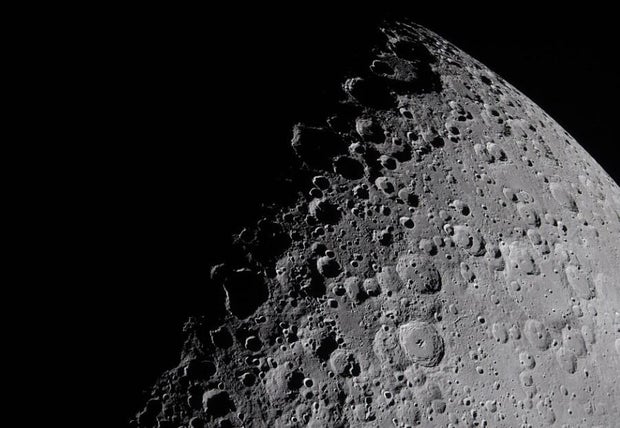
The Artemis II crew is now making their trip back toward Earth. They are expected to splash down off the California coast, near San Diego, on Friday evening.