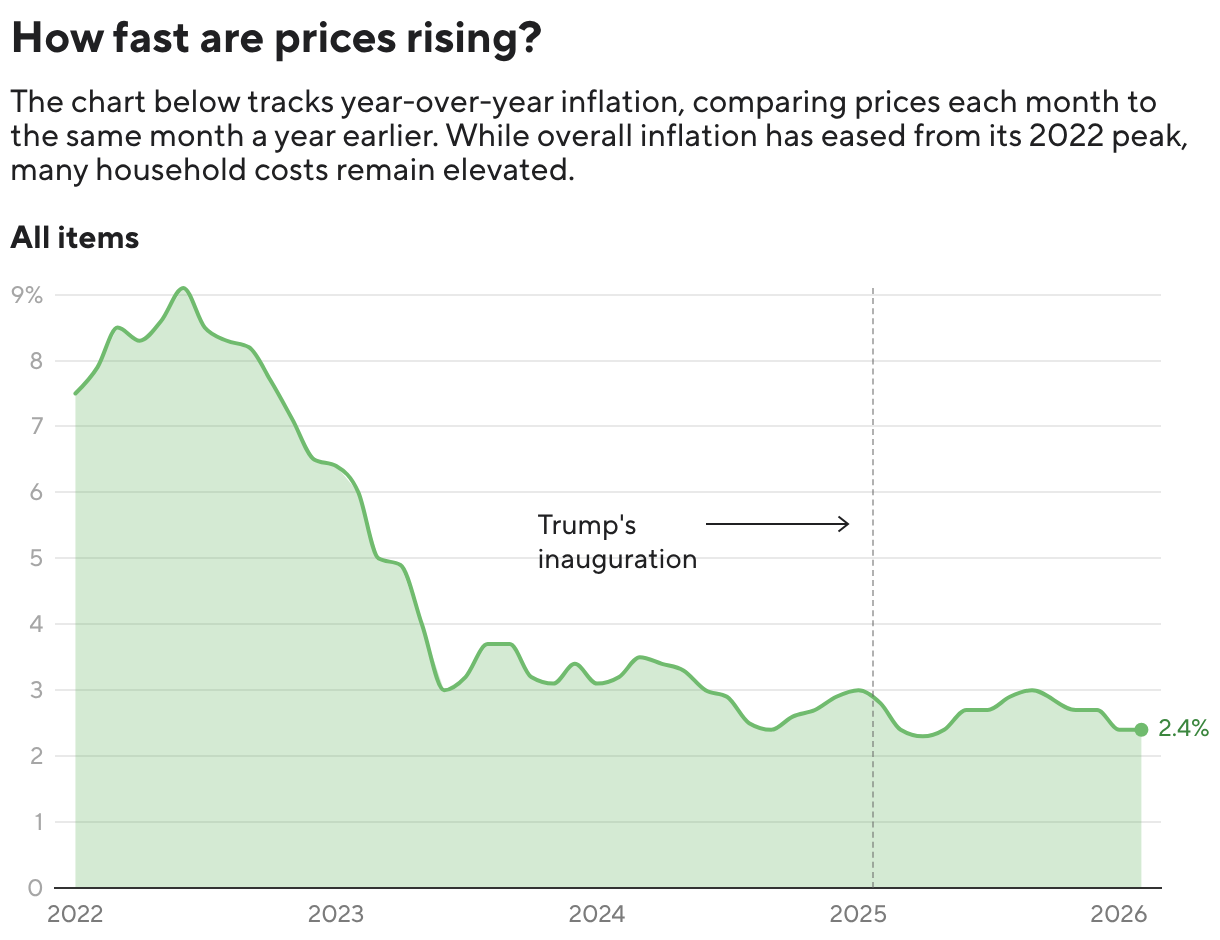
The Consumer Price Index rose at an annual rate of 2.4% in February, unchanged from the prior month and representing a cooler pace than economists had forecast.
The Labor Department data captures the period before the Iran war broke out in late February. Since then, oil prices have surged, driving inflation concerns among investors.
“Inflation was starting to ease in late 2025 and early 2026, but that will be short-lived as the war in Iran triggers price increases for energy, food and other items,” said Heather Long, chief economist at Navy Federal Credit Union, in an email.
By the numbers
Inflation was forecast to rise 2.5% last month, according to economists polled by financial data firm FactSet. The CPI, a basket of goods and services typically bought by consumers, tracks changes in those prices over time.
Inflation has averaged 2.5% over the last three months, compared with about 2.9% in August, September and November. October’s CPI report was canceled because of the government shutdown.
So-called core inflation, a measure of CPI that excludes volatile food and energy prices, rose 2.5% on an annual basis. That’s unchanged from January, according to the Bureau of Labor Statistics.
Food costs rose faster than overall inflation, rising 3.1% on an annual basis, while food away from home — or the cost of eating out — jumped 3.9%.
Consumers got a break at the pump last month, with gasoline tumbling 5.6% on an annual basis. But that progress is all but sure to be erased in March, given that gas prices have surged by almost 60 cents per gallon, or about 20%, since the outbreak of the Iran war.

Iran-driven inflation fears
The Iran war threatens to stall or even reverse progress in taming inflation, with rising oil prices pushing up gasoline costs and potentially spilling over into other parts of the economy, economists say.
“The path towards disinflation has become murkier,” said Deutsche Bank analysts in a March 10 research note. Higher energy prices could “lead to higher headline inflation” in the coming months, they added.
U.S. consumers are already feeling the effects at the gas pump. On Wednesday, the average cost for gasoline in the U.S. stood at $3.58 per gallon, up from about $3 per gallon before the war, according to data from AAA.
While oil prices have receded in the last two days after reaching above $100 per barrel, experts say gas prices are unlikely to drop to the levels they were at before the war began. That’s partly due to seasonal factors that cause gas prices to rise in warmer months, according to Patrick De Haan, a petroleum expert at GasBuddy.
Gas prices may stall at $3.55 to $3.65 before gradually dipping to around $3.25 over the next month, De Haan said.
The rising cost of oil has broader implications for the U.S. economy and consumers beyond the gas pump.
“It will have knock-on effects on a whole range of goods that Americans will feel in the coming months,” said Ian Bremmer, founder of Eurasia Group, a global political risk research and consulting firm.
The Strait of Hormuz is also a key conduit for fertilizer and other agricultural industry inputs, and depending on how long it remains effectively closed, food prices in the U.S. could start to rise, too, Bremmer added.
What the experts say
February’s inflation data isn’t likely to draw much investor focus, given the inflation pressures emerging in March with surging oil prices, said Adam Crisafulli, the head of Vital Knowledge.
“People are going to be waiting to see how oil impacts inflation readings over the coming months,” he said, adding that investors will be monitoring how the rise in energy prices potentially bleeds into other categories like plastics, which is a petroleum-derived product.
The inflationary pressures from the Iran war could also change the calculus for the Federal Reserve as it weighs when to next cut interest rates. Markets are now pricing in another rate cut in July or September at the earliest, analysts say.
The Fed will make its next rate cut decision on March 18.
“It is generally assumed — and we agree — that the Fed is going to be on hold for longer now, as they wait to see if inflation expectations rise and become embedded, or if everything will go back to where it was prior to the military operations in the Middle East,” said Chris Zaccarelli, chief investment officer for Northlight Asset Management, in an email.
The central bank is tasked with keeping inflation low while fostering full employment. Last month’s employment report showed the economy lost 92,000 jobs, which could bolster the argument for rate cuts.
However, cutting interest rates could fuel more inflationary pressures, on top of rising gas and oil prices.
The risk of higher oil prices “translates into a Fed that will remain cautious about cutting interest rates,” said Ellen Zentner, chief economic strategist for Morgan Stanley Wealth Management, in an email.