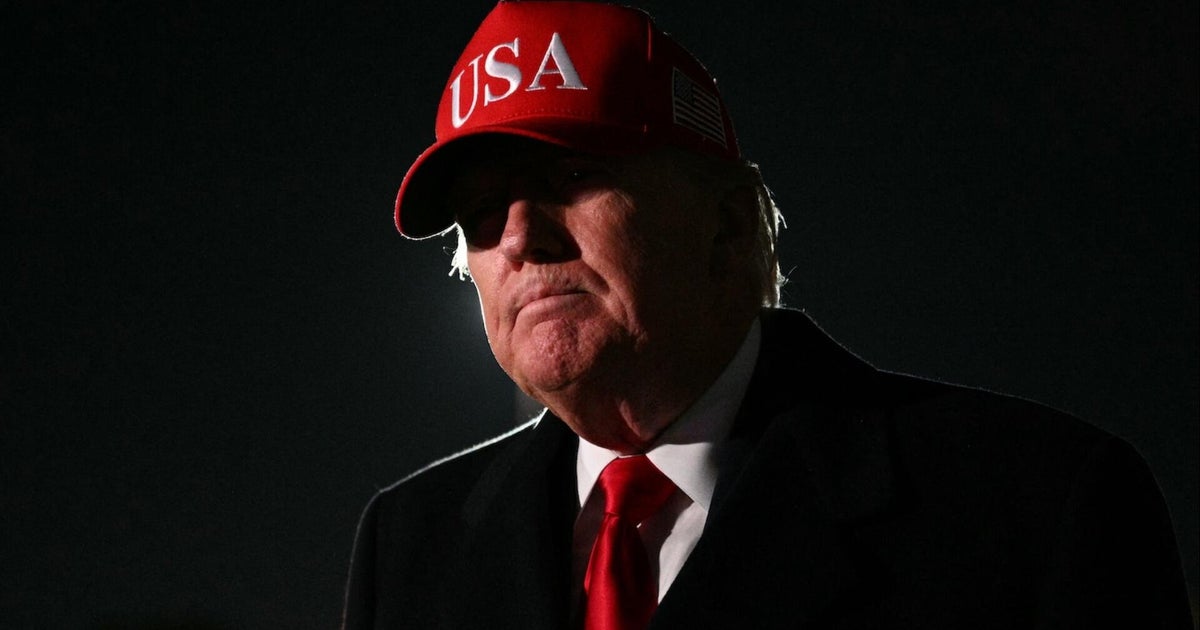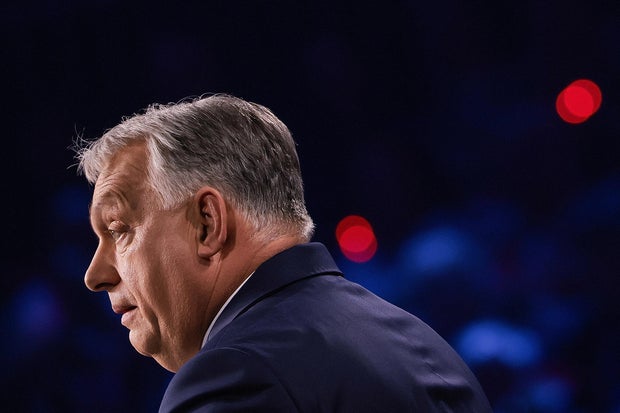
Hungary’s Viktor Orbán was one of President Trump’s favorites. During his 16-year term in office, Orbán openly championed Mr. Trump’s reelection and the two men got into frequent, detailed exchanges on political and governing strategy.
In the run-up to Sunday’s election, Vice President JD Vance flew to Budapest and called for people to vote for the incumbent.
But in the end, none of that mattered. Orbán conceded, ending his 16-year iron grip on power.
Mr. Trump has lost his biggest cheerleader in Europe. So who’s the guy replacing him?
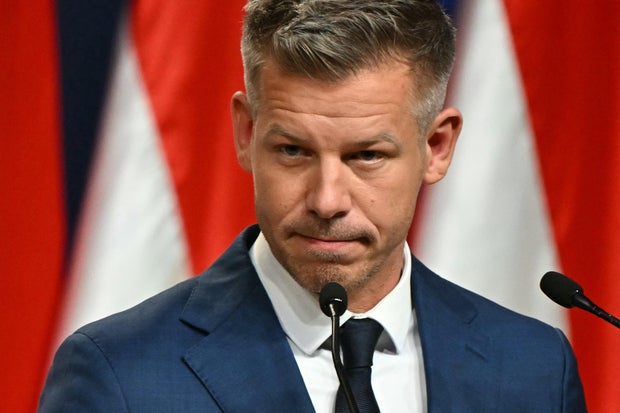
Meet Péter Magyar. Hungary’s new prime minister — whose name literally means “Hungarian” — is a young, well-dressed lawyer who campaigned on promises to crack down on corruption, tax the wealthiest and unlock billions of frozen European Union euros.
He is far more pro-EU and anti-Russia than his predecessor.
Attila Kisbenedek/AFP via Getty Images 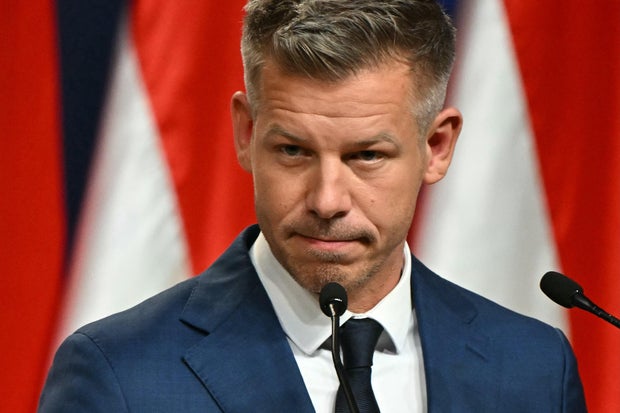
While Ukraine’s Volodymyr Zelenskyy and EU leaders have welcomed the election’s result, Russia’s Vladimir Putin has not. Russian state TV has even claimed that “European hawks” and “the head of the Kyiv regime” interfered in the election to oust Orbán.
Once an Orbán fan
Magyar grew up admiring Orbán as Hungary transitioned out of the Soviet Union in the 1990s. He reportedly had a photo of Orban — who at the time was more known as an anti-communist freedom fighter — on his bedroom wall as a child. But after holding several roles as a member of Orbán’s Fidesz party, he resigned in 2024, expressing deep dissatisfaction with what he said was a culture of mass corruption under Orbán’s leadership.
The relationship between the two men soured further in February, when Magyar accused Fidesz of a “Russian-type” blackmail operation using a secretly recorded video showing Magyar having consensual sex with his now ex-girlfriend at a house party.
“Even in Europe, it is unprecedented for a ruling party to attempt to discredit, blackmail, and neutralize its main political opponent by secretly recording their sexual acts using illegal methods and threatening to make the recordings public,” he posted on social media.
The tactics failed. A record 77.8% of eligible Hungarians went to the polls Sunday — roughly 6 million in a country of 9 million.
The result was resounding. Magyar’s upstart party Tisza won an astonishing two-thirds of a parliamentary supermajority, which gives him a mandate to dismantle what he calls the authoritarian system that Orbán has built. He has also pledged to move Hungary into a closer relationship with its EU partners.
But Magyar also has conservative anti-immigration views: He has said in the past that the EU needs strong border protection and that he opposes redistribution of asylum-seekers across Europe.
So while President Trump may have viewed Orbán as an ideological soulmate, there also might be some areas of common ground with his new counterpart.