About 350 Whirlpool factory workers in rural Iowa will lose their jobs on March 9 — a blow to a community where the plant has anchored the local economy for eight decades. The layoffs are also another sign of U.S. manufacturers’ ongoing struggles, which have persisted despite the Trump administration’s pledge to revive the sector.
In April of 2025, President Trump said that “jobs and factories will come roaring back into our country” due to his tariff policies, which sharply raised taxes on imports from nearly every U.S. trading partner. Although some companies have responded to the tariffs by promising to invest in the U.S., building those factories could take years. Such commitments are also nonbinding, leaving it unclear when, or if, such projects will be shovel-ready.
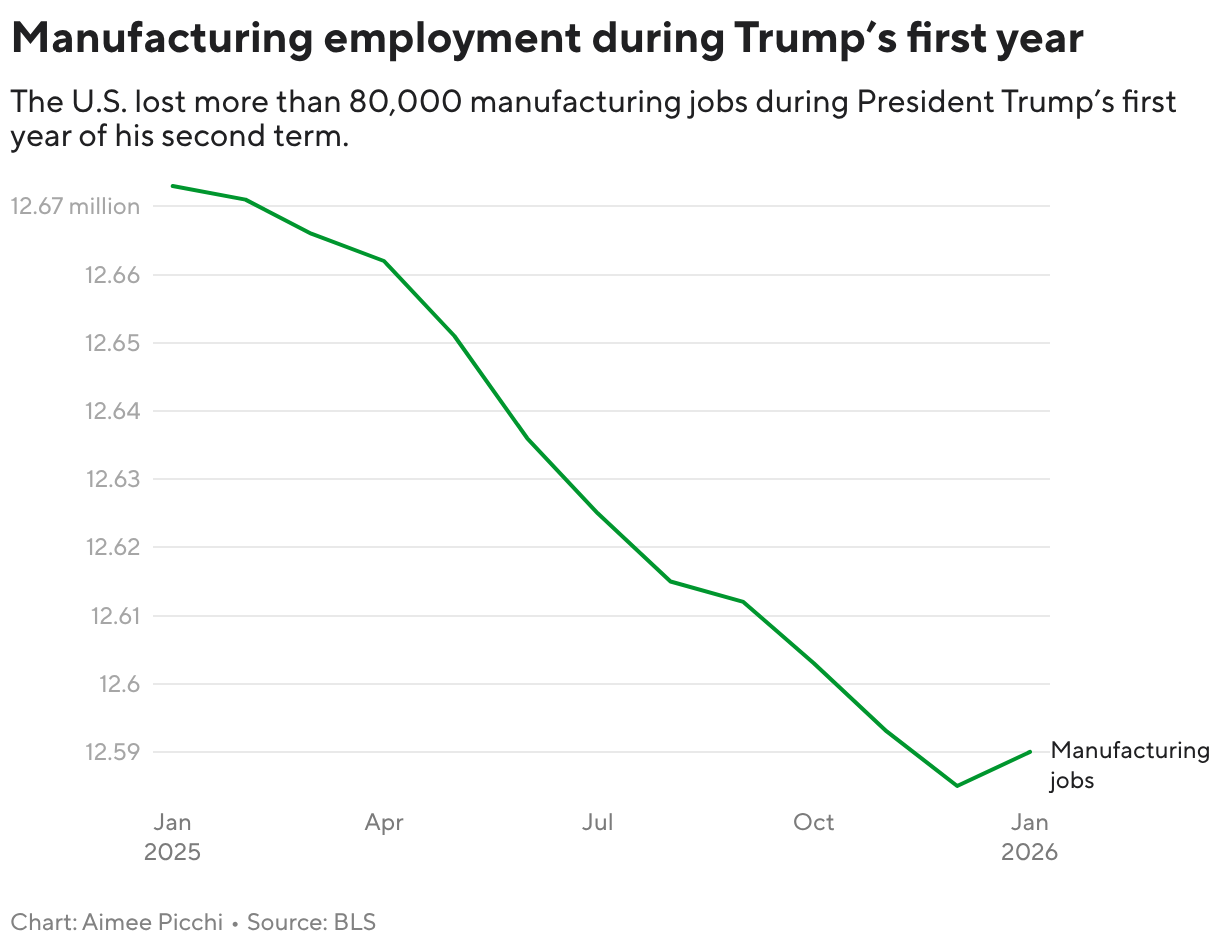
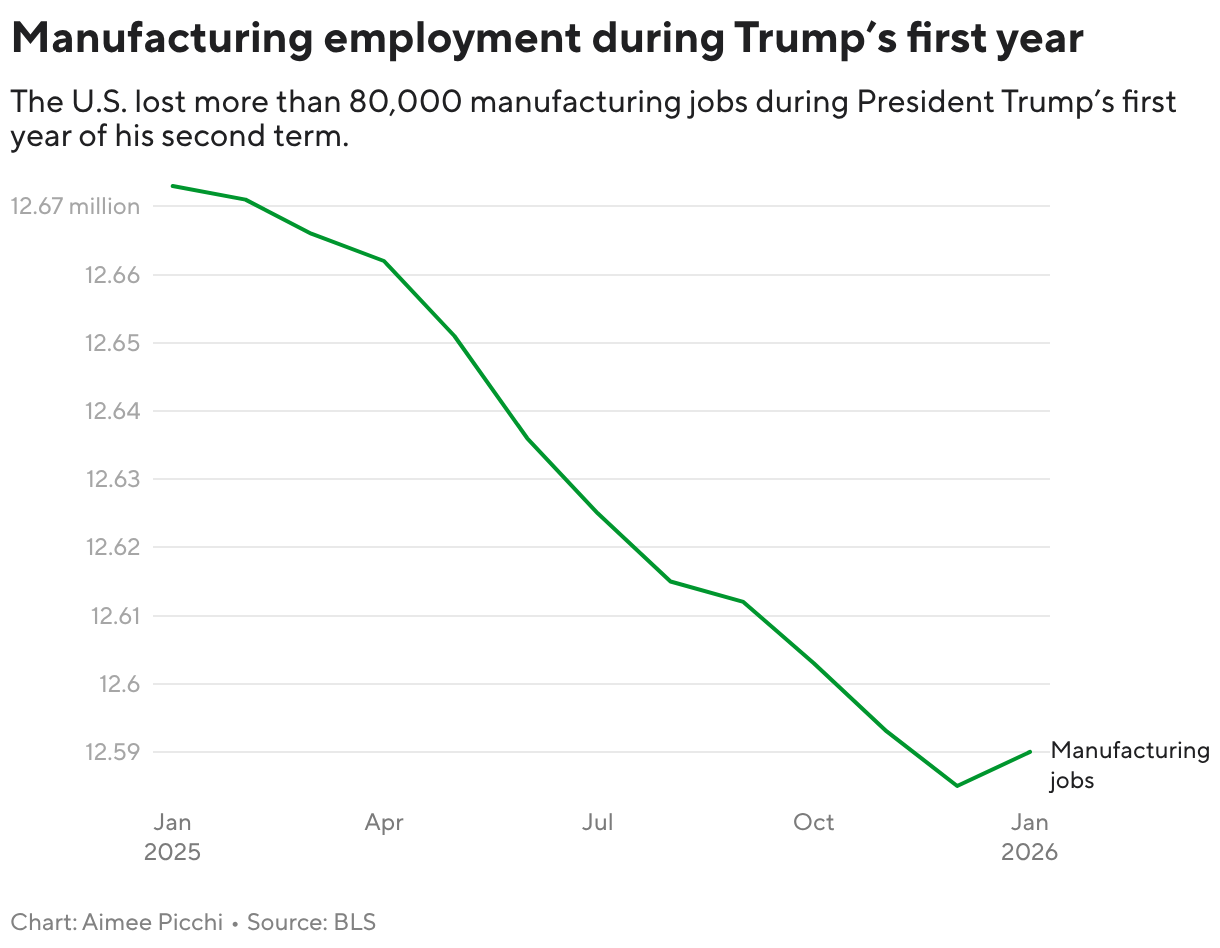
In the meantime, employment data shows American manufacturers are continuing to cut jobs, with the U.S. shedding 83,000 manufacturing jobs during Mr. Trump’s first year in office. Economists point to a range of factors for the job losses, including automation, long-standing headwinds from lower wages overseas to increased costs and economic uncertainty partially caused by the Trump administration’s tariffs. Those import duties have hurt some U.S. manufacturers that rely on imported parts and goods to make their products domestically.
“Jobs are still in jeopardy”
The union that represents the workers at Whirlpool’s Amana, Iowa, plant appealed to Mr. Trump for help in a Feb. 24 letter, citing his “America First” manufacturing pledge and asking him to “demand that Whirlpool halt these planned layoffs.” The labor group said it hasn’t yet received a response from the White House.
“This is a story that needs to be told to the American public,” Brian Bryant, international president of the International Association of Machinists (IAM), the union that represents about 1,300 Whirlpool workers, told CBS News. “Everything’s not rosy in this country, and every day, workers’ jobs are still in jeopardy by corporations that favor profits over the workforce.”
He added, “As much as this administration preaches that they’re going to stop that, we’re not seeing that.”
The White House didn’t reply to a request for comment.
In a statement to CBS News, Whirlpool said the planned job cuts are part of a “multi-year modernization plan that will position the Amana plant for stability and success.”
The publicly traded company, which has a market worth of $3.9 billion, is the biggest U.S. manufacturer of appliances. In 2025, Whirlpool reported net income of $318 million on sales of $15.5 billion.
Manufacturers face multiple challenges, from the cost of the Trump administration’s tariffs to long-term competitive pressures, economists told CBS News.
The Trump administration’s tariff policies are also in flux, adding to the uncertainty facing many U.S. businesses. Last month, the Supreme Court struck down the president’s “liberation day” tariffs, although Mr. Trump imposed new global tariffs of 15% shortly after the ruling.
“The last year was a continuation of a long-standing trend — nothing pivoted, nothing reversed,” said Aaron Terrazas, an economist with Gusto, which provides payroll services to small and midsize businesses.
The U.S. has lost 4.5 million manufacturing jobs since 2000. By comparison, overall global manufacturing employment over that period has increased by about 71 million workers, with most of that growth in China, India and Vietnam, according to a 2025 research brief from the Federal Reserve Bank of Cleveland.
One of the many goals of Mr. Trump’s tariffs is to sufficiently raise the cost of production outside the U.S. so that companies have an economic incentive to reshore their factories and hire American workers.
But some domestic companies are still finding it cheaper to shift jobs overseas. A 2025 survey from the Reshoring Institute, a nonpartisan think tank focused on returning manufacturing to the U.S., found that one-third of U.S. equipment manufacturers said they were planning to move their production offshore, citing cost as the main impetus.
Whirlpool’s plant in Amana, whose population is less than 1,000 people, has itself felt the impact of that trend, union officials told CBS News. The factory now has about 1,300 workers, down from 3,000 employees in 2020, with jobs being shifted to a Whirlpool plant in Mexico, IAM’s Bryant said.
“If you look at the last 20 years, they’ve invested over a billion dollars into beefing up their Mexico manufacturing, and their exports that are coming out of Mexico have exponentially increased,” he said. “This is not modernization — this is offshoring of jobs.”
A shifting economy
A key yardstick for the U.S. labor market, payroll processor ADP’s monthly employment report, showed on Wednesday that the U.S. lost 5,000 manufacturing jobs in February, even as the private sector as a whole added 63,000 jobs last month.
“Almost all the growth was coming from health care,” Laura Ullrich, Indeed’s director of economic research for North America and a former official at the Federal Reserve Bank of Richmond, said of the latest ADP numbers.
Health care jobs also drove U.S. employment growth last year, a trend that Ullrich predicts will continue in 2026 due to demographic changes such as the aging baby boomer generation, whose members are requiring more medical services.
“I think we’re likely to see an outsized share of whatever job growth we have in that sector, and stagnation in the other sectors,” Ullrich told CBS News.
About 12.6 million Americans were employed in manufacturing at the start of 2026, or about 8% of the U.S. workforce — down from a peak of 38% in World War II, according to the Federal Reserve Bank of Cleveland.
Although manufacturing jobs aren’t as prevalent as they once were, these jobs still offer comparatively higher earnings for workers without college degrees, data shows. Manufacturing employees earn an average of about $36.20 per hour, above the $26 hourly pay for retail workers and $23.38 for leisure and hospitality employees, according to the Bureau of Labor Statistics.
“Manufacturing today isn’t the same as it was in 1950 — it’s a different type of work,” Gusto’s Terrazas said. “It’s this incredibly diverse sector. We tend to think of it as a Rust Belt ideal, but there is a lot of small light manufacturing as well,” such as local coffee roasters or food manufacturers.
But small manufacturers tend to be more sensitive to tariff costs and other economic headwinds, given they have less leeway to absorb financial shocks than bigger firms, Terrazas noted. For instance, many small U.S. coffee roasters were among those hit by the Trump administration’s tariffs, although the White House granted an exemption for coffee tariffs in November.
One roaster in Portland, Oregon, told CBS News in December that the increased costs from tariffs had forced him to lay off two full-time employees. “Now it’s down to just myself and one part-time employee,” Charlie Wicker of Trailhead Coffee Roasters said. “The fact that we’re still standing is a function of having a little bit of savings to keep the lights on.”
Layoffs would “hollow out” a community
Whirlpool’s Amana division is one of those old-school factories that underlined the U.S.’ industrial strength. Founded in 1934 by inventor George Foerstner, the Amana company developed several refrigeration innovations, from the first upright home freezer in 1947 to the first bottom-freezer fridge in 1957, according to the company’s website. Whirlpool bought the Amana brand in 2006.
The job losses at the Amana plant will be devastating for the local economy, which is heavily dependent on agriculture and manufacturing, said Kerry Waddell, an IAM representative who worked at the Amana factory for 36 years, beginning in 1987.
“These are employees that spend their money in these communities, they send their kids to the schools there,” he told CBS News. “At this time, they’re getting laid off, they’re losing their health insurance — on March 9, they lose it immediately.”
Some Iowa lawmakers are asking Whirlpool to reconsider the job cuts, including Reps. Mariannette Miller-Meeks and Ashley Hinson, both Republicans. The office of Iowa Gov. Kim Reynolds didn’t immediately respond to a request for comment.
“These layoffs would hollow out a community and undermine the very domestic manufacturing base that American workers have spent decades building,” they wrote in a letter to Whirlpool.
As of now, Whirlpool’s job cuts are still on track, and the union said the company has indicated there may be more layoffs in store.
“If something doesn’t change, you’re looking at the workforce shrinking down to 500 to 600 people” at the factory, Bryant said. “This, unfortunately, is not just a Whirlpool issue — we’re seeing it elsewhere in the IAM.”
“There’s a major problem, and it’s time for the federal government and the state governments to get involved in this,” he added.