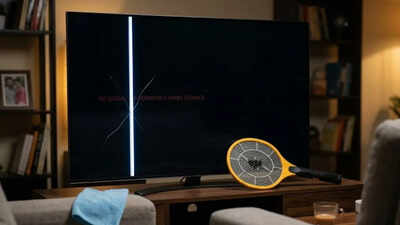
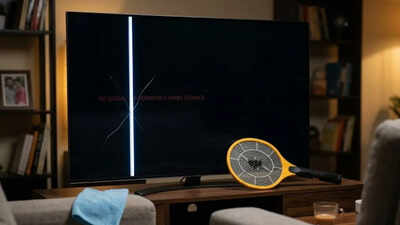
Imagine your favourite TV show interrupted not by a commercial, but by a sudden, permanent failure signalled by a thick black line across the entire screen, never to return! This frightening situation is more common now than ever before because of something that is found in millions of households across the country – the electric mosquito bat/racket! If you are trying to kill a mosquito buzzing near your television, and your high-voltage sparking racket is anywhere near the television’s LED or OLED display panel, your racket could create a strong enough electromagnetic pulse (EMP) to destroy the sensitive internal electronics of your display.
How electric mosquito rackets can trigger instant TV failure
Modern displays are made using extremely thin transistors; these transistors cannot withstand the tremendous electrical static discharge and localised interference that electric mosquito rackets create. Therefore, even just one mistimed ‘zap’ with an electric mosquito racket too close to the edge of the frame around the display can cause an immediate short-circuit in your T-Con board (the logic board for driving your LCD panel), resulting in a small cost pest problem turning into a big replacement cost.Mosquito bats may seem like toys, but they are actually high-voltage capacitors. When you swing the bat at an insect, and it gets zapped, what actually happens is that a circuit has been completed, causing the components to induce a surge in a tiny fraction of a second. This creates a localised Electromagnetic Interference (EMI) or miniature Electromagnetic Pulse (EMP). New LCD and OLED TVs utilise millions of tiny transistors and super-thin copper traces, making them act as antennas for this stray energy. Therefore, even if you never physically touch the display with the mosquito bat, the pulse of energy can jump through the air, causing the components to induce a surge into the TV’s internal wiring, which they were not designed to handle.
Why modern screens can’t take the heat
Older ‘box’ TVs, or CRTs, were very strong and well protected, while today’s thin flat panel displays are extremely fragile. The most commonly damaged part in a flat panel display is the T-Con board (Timing Control Board). The T-Con board processes video signals and tells the display what images to show. The T-Con board is often located near the edge of the screen, which is where most people will swing to hit a mosquito that is resting on the bezel. The COF (Chip-on-Film) ribbons, which are embedded directly on the glass panel and are hair-thin, are very susceptible to damage caused by static electricity. If a person using a nearby racket produces static electricity, it can cause the COF transistors to ‘gate-short’, causing vertical or horizontal lines on the display and destroying the entire display panel.
How to safely handle pests near electronics
A ‘no-fly zone’ should be established for electric rackets to protect your television. If you see a mosquito on or around the screen, please do not reach for your racket and try to swing at it. Instead, gently shoo it away from the screen using a soft microfiber cloth and to another part of the room before using the racket. Alternatively, you may want to consider using UV-based suction traps or plug-in ultrasonic repellers near your entertainment centre, as these methods manage pests without producing the high-voltage arcs that pose a risk to your screen. If you do have to clean your screen, always make sure to unplug the TV before doing so to avoid any static electricity from discharging on the TV when cleaning it.