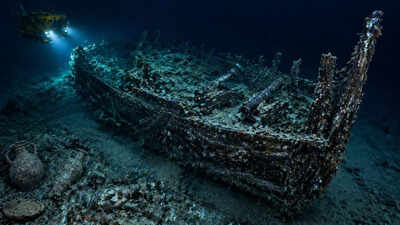
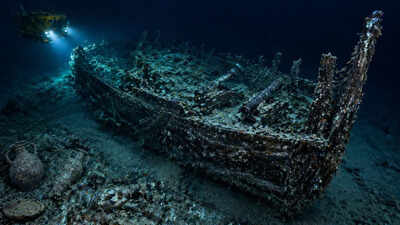
A marine exploration venture in the Mediterranean unexpectedly discovered a shipwrecked pirate ship nearly 3,000 feet underwater. This shipwreck was uncovered in a search for the English warship HMS Sussex conducted by Odyssey Marine Exploration in 2005.However, what they found was a different wreck that had been left untouched for over 260 years. It was later discovered that the ship belonged to the Algerian pirates who roamed the Mediterranean at that time, and it was one of the first of its kind to be discovered in the area. This discovery was reported recently in Wreckwatch magazine, according to editor-in-chief Sean Kingsley.
Barbary corsair shipwreck shows hidden naval power
The boat was classified as a tartane, a type of fast and agile ship used in the coastal areas. Although its length was about forty-five feet, it had heavy armaments consisting of four cannons, swivel guns, and rifles for up to twenty people.The fact that the ship was heavily armed shows that it was intended for fighting, not trading. In addition, it was designed in such a way that it appeared to be an innocent fishing boat and could approach other vessels unnoticed by corsairs.
How a 45-foot tartane carried heavy firepower
The artefacts unearthed from the shipwreck reveal the expansive geographic nature of piracy. The scientists unearthed glass bottles possibly manufactured in Europe, ceramic ware from Ottoman Turkey, and other mundane artefacts sourced from Algeria.The mixed composition of these artefacts from various regions indicates that the ship must have acquired these artefacts by way of raiding or capturing ships on water, unlike in the case of regular trade activities.
Why Barbary pirates impacted European maritime history
The Barbary corsairs were in operation between the sixteenth century and the early nineteenth century, operating from ports along the coast of North Africa, like Algiers. They differed from pirates because of the well-organised attacks they carried out, which would impact whole areas of coastal settlements all over Europe.They were known to conduct themselves not only in the Mediterranean but also in the Atlantic Ocean, attacking and looting ships and even settlements along the coasts. Their loot was used for ransoming, which made them a significant menace to the shipping industry of their time.
Deep-sea conditions preserved the pirate shipwreck
The depth of the shipwreck proved crucial for the preservation of the vessel. Its bottom was still intact under thick layers of soil, free from any biological or human tampering.Nonetheless, other parts of the vessel that were not covered in soil slowly deteriorated due to marine creatures. Nonetheless, the partially damaged vessel still stands out as one of the best-preserved corsair ships, helping us learn more about shipbuilding practices in the 18th century.
Pirate shipwreck dating explains its final moments
It is estimated by researchers that the ship was lost somewhere between the middle of the 18th century. The dating of the artefacts retrieved from the wreckage of the ship, which includes bottles and other ceramic objects, is what helped them make the estimation.As the wreckage has not been discovered for centuries, it serves as an intact piece of history regarding the pirates of that time. It helps in studying the movement of the pirates and other aspects related to their life and activities.
Underwater archaeology expands knowledge of pirate history
The find constitutes valuable tangible evidence of Barbary corsair activities that have been mainly analysed using documentary evidence. Archaeologists highlight the importance of such findings in providing tangible proof of maritime activities and bridging knowledge gaps.Finds from this excavation may prove useful for shedding light on navigation skills and other maritime aspects. This discovery contributes to accumulating more evidence indicating that archaeology carried out under the sea can radically change our perception of maritime history.