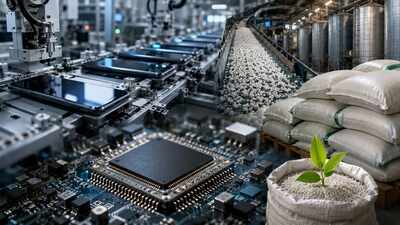
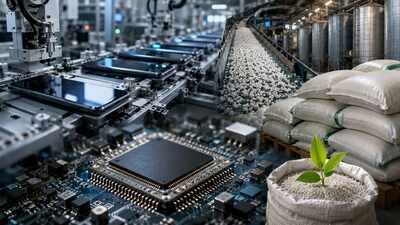
Building a deep manufacturing base spread across multiple sectors is emerging as a cornerstone of India’s strategy to future proof itself against supply chain disruptions caused by geopolitical disruptions. Reports suggest that the government is working on identifying an extensive list of products for a fresh manufacturing push.The move comes at a time when the US-Iran conflict has impacted several industries and thrown fresh light on India’s imports-driven supply chain vulnerabilities. The aim is also to limit the pressure on rupee. The idea is to reduce trade deficit, conserve foreign exchange reserves and also to position India as an alternative global manufacturing hub to China. Meanwhile, consumer goods and electronics companies have stepped up contingency planning ahead of the festive season. Renewed US-Iran tensions and a weaker rupee are threatening their supply chains. Manufacturers are advancing imports from China, increasing buffer stocks of raw materials and components, and leasing additional warehouse space to guard against delays, rising freight costs and higher input prices following fresh disruptions around the Strait of Hormuz.What is being planned by the government and how will the focus on the manufacturing sector help India reduce its dependence on global supplies?
Manufacturing push for 100 items
India targets raising the share of manufacturing in GDP to 25% by 2035. And while that appears to be an ambitious target, given the fact that the share currently stands at around 17%, steps are being planned to focus on sectors where reducing import dependence will help.The government is examining a range of measures, including subsidies and other incentives, to encourage local production.
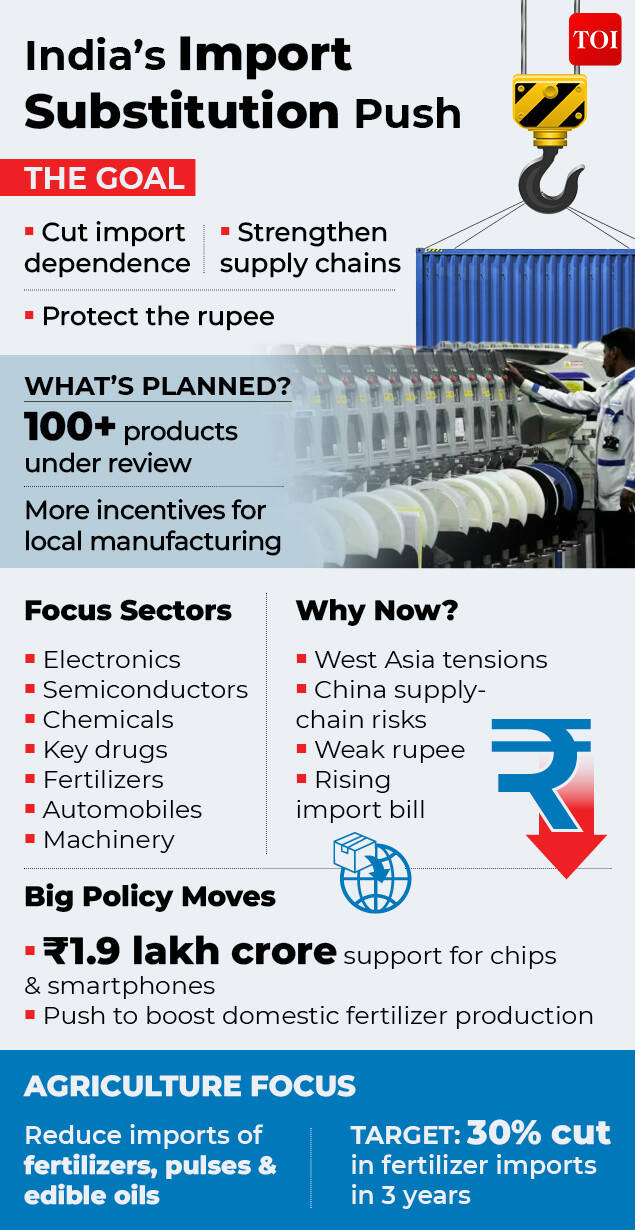
India’s Import Substitution Push
The Ministry of Commerce and Industry is reportedly preparing a list of more than 100 products that could see increased domestic manufacturing. The list spans sectors such as electronics, chemicals, essential pharmaceuticals, fertilisers, semiconductors, automobiles and machinery. Reports suggest that key ministries have been asked to identify the products where India is still heavily dependent on imports. The idea is to examine whether import substitution via domestic manufacturing is a viable alternative.Products where import dependence can realistically be reduced are being identified. There is reportedly acknowledgement that gold, oil, and critical minerals cannot be easily substituted.Earlier this month, the Cabinet cleared two schemes worth Rs 1.9 lakh crore for chips and mobile phones. These aim at taking India’s electronics manufacturing ambitions from beyond assembly lines into semiconductor fabrication, advanced packaging, materials and homegrown mobile phone brands. Semicon 2.0 with an outlay of Rs 1,27,500 crore was cleared and Mobile Phone Manufacturing Scheme (MPMS) with a budget of Rs 62,500 crore also got a nod.A Bloomberg report says that a Shaktikanta Das-led taskforce is working on the import substitution roadmap. Once products are identified, incentives for private and foreign investors as well as capacity expansion by state-owned enterprises through joint ventures will be rolled out.Plans are also under consideration including reducing the imports of pulses, edible oils and fertilisers through domestic production. Fertilizers have also been identified for reducing import dependence.Officials are also examining policy changes to encourage exporters to use more domestically produced capital goods and intermediate products by relaxing certain export obligations and value-addition norms.
Why is it important & what should be done?
Experts call for a nuanced manufacturing strategy that deals with both the immediate supply chain bottlenecks and also focuses on strategic items for the long term.India’s import structure shows that a handful of product categories, especially electronics and electrical equipment, are driving import growth. Electronics imports in particular are up 43% in the first three months of the current fiscal. It is also important to note that for many of these products, India’s import dependence is concentrated on a handful of countries. India’s non-oil and non gems and jewellery merchandise trade deficit rose 16% in FY26, from $110 billion to $139 billion. In the first three months of the current financial year, it’s up 36% to $49 billion.
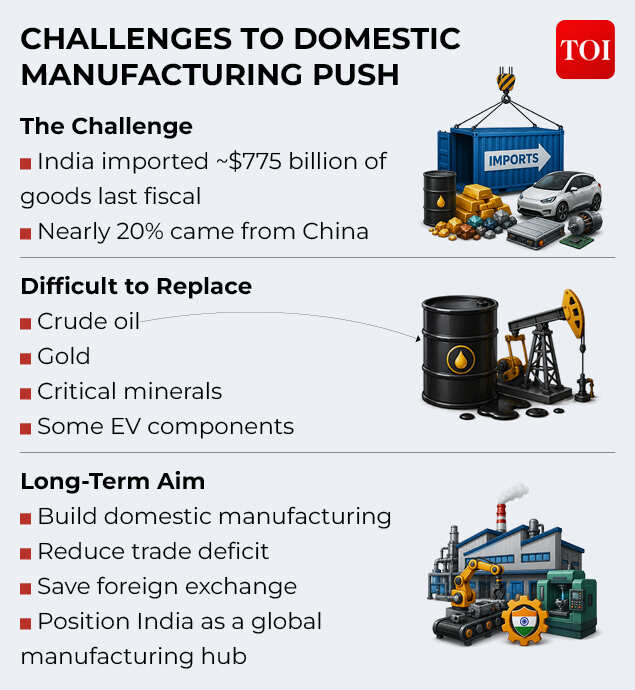
Challenges to Domestic Manufacturing Push
Rajnish Gupta, Partner, Tax and Economic Policy Group, EY India says there is a dual rationale for building domestic manufacturing here, reducing supply chains risks, and creating greater economic activity within India.“The reasons why a particular product is not manufactured in India could vary. It could be due to technology gaps and IP constraints, lack of economies of scale, or supply chain related issues. That means the government developing a product level investment plan that addresses the particular constraint. Specific global players who would manufacture any of these products would need to be identified and then the plan would need to be implemented,” he tells TOI.“Along with these plans, the government should continue with the ongoing reforms that improve ease of doing business and lower the cost of doing business through reductions in logistics costs, power costs, cost of land and cost of capital. Ultimately, how far India can go toward self-reliance in each of these product categories depends on how fast these granular plans actually get built out and implemented. Given the current global context and the flurry of FTAs that India is finalising, we should see a high level of manufacturing investments in the coming years,” he adds.Radhika Rao, Senior Economist and Executive Director at DBS Bank believes that the move to lower reliance on imported inputs and the build up of manufacturing capabilities is an important policy endeavor. “Industries best positioned to succeed are those where domestic demand is sufficiently large, existing capabilities provide a foundation for scale-up, and technological gaps remain manageable. Key beneficiaries include electric vehicles, electronics manufacturing, pharmaceuticals and APIs, and renewable energy,” she tells TOI. Though she points out that given long gestation periods, limited ecosystem depth, resource constraints, and technological barriers, a phased expansion of supporting and ancillary industries may prove more effective than pursuing comprehensive domestic value-chain integration across these sectors.Ranen Banerjee, Partner and Leader, Economic Advisory, PwC India advocates a longer term strategic aim that looks at items that India imports as fully built or completely knocked versions. “We should be looking at the components of these items that could be indigenised and here it has to be a collaboration with multiple sets of geopolitically aligned countries with OEMs (Original Equipment Manufacturers) based in such countries with IP protection ensured for such OEMs. This will help not only to reduce the value of the imported item but also plug into the supply chain of such OEMs,” he tells TOI.He admits that India cannot isolate itself and try to become self sufficient or house an entire supply chain within the country. “This (exercise) has to be undertaken at two levels – strategic, which is long term resilience and tactical which will be to reduce imports in the short term. There are several items that could be easily manufactured in India but we import them because our capacity could be lower. We therefore need to identify those items and have a capacity addition support program from the government so that we could become net exporters of those component items. This would be a tactical intervention with quick wins,” he concludes.