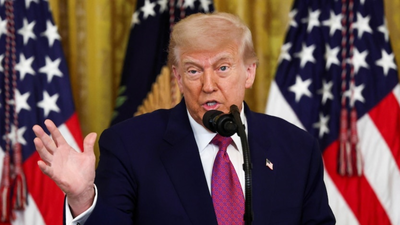
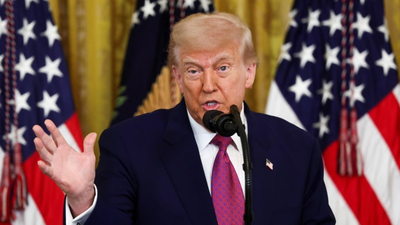
US President Donald Trump on Monday said Washington was holding “good talks” with Iran and expressed hope that negotiations could lead to an agreement. However, he warned that the United States would resume military strikes if diplomacy failed.Speaking to reporters, Trump said there was a real possibility of reaching a deal but made it clear that military action remained an option. “We’re having good talks. I think there’s a good chance that something could happen, and if it does, good, if it doesn’t, we go back to doing what we were doing two days ago,” he said.Later, while addressing a campaign rally in Michigan, Trump adopted a tougher tone and said Iran could not be persuaded through incentives alone.“You can’t bribe them. You’ve got to beat them, and we’ll beat the hell out of them. But we’ll see how it turns out. Right now, there are very friendly negotiations going on,” he was quoted as saying by news agency Reuters.Despite Trump’s remarks, tensions remained high across the region. Saudi Arabia, Jordan and Iraq reported drone attacks on Monday, suggesting that hostilities had not completely subsided despite the pause in the US bombing campaign.Washington halted its two-week air campaign against Iran on Saturday in a surprise policy shift by Trump after nearly five months of conflict. Iran said it had not abandoned diplomacy but denied reports that it had sought talks with Washington.Foreign ministry spokesperson Esmail Baghaei said messages continued to be exchanged through mediators but insisted that claims Iran had requested negotiations were “fabricated”. “This is not in our DNA,” he said.A senior Iranian official had earlier told Reuters that Tehran would suspend its attacks as long as Trump maintained the ceasefire announced by the United States.However, Iran’s central military command later accused the United States of threatening ships and oil tankers in Iranian waters and attempting to impose what it described as an illegal maritime blockade, calling it a further escalation of the conflict.Saudi Arabia said it intercepted drones targeting petroleum facilities, including sites in Riyadh. The kingdom alleged that the drones had been launched from Iraq by Iran-backed armed groups and said it reserved the right to respond.Meanwhile, Yemen’s Houthi movement, which is backed by Iran, claimed responsibility for targeting Saudi Arabia’s East-West oil pipeline leading to the Red Sea port of Yanbu. The group said the attack was carried out in retaliation for Saudi drone operations.Tehran also maintained that it remained in control of the Strait of Hormuz, one of the world’s most important oil shipping routes. The issue remains a major point of disagreement, with Washington insisting that commercial vessels should be allowed to pass freely, while Iran says it has the authority to supervise traffic through the waterway.The easing of military action and Trump’s comments on possible negotiations sent global oil prices sharply lower. US crude dropped more than eight per cent to $81.98 a barrel, while Brent crude fell over nine per cent to $87.77.The conflict has also become a political issue in the United States ahead of the November midterm elections. A Reuters/Ipsos poll conducted over the weekend showed Trump’s approval rating rising to 37 per cent, although only around one in three Americans supported the military campaign against Iran. Many respondents said the President had failed to clearly explain the objectives of the war.According to Reuters and several US media reports, Trump’s decision to suspend the bombing followed advice from military commanders who believed the operation had reached the limits of what it could achieve. Officials reportedly warned that the military was running out of suitable targets and raised concerns over the depletion of air munitions.Trump rejected suggestions that the United States faced ammunition shortages, saying stocks were being replenished quickly after supplies had been sent to Ukraine. He added that he wanted more of the military’s most advanced weapons. Iranian state media also claimed that six foreign vessels attempting to cross the Strait of Hormuz without permission had been turned back on Monday.The latest phase of the conflict began after the United States launched renewed air strikes in response to Iranian attacks on shipping using a route promoted by Washington near the Omani coast. Iran insists that vessels should instead use a channel closer to its own coastline, where it says it has the right to regulate transit and levy fees.The two-week US bombing campaign killed scores of people in Iran and damaged military sites as well as bridges and tunnels in the country’s south. Four American service members were killed in retaliatory attacks on US bases in neighbouring countries, while Iran also targeted civilian infrastructure in Gulf states, saying the strikes were in response to US military action.Although Washington and Tehran agreed in June on a framework for negotiations to address issues including Iran’s nuclear programme by the end of August, both sides continue to disagree over the interpretation of provisions relating to navigation through the Strait of Hormuz.