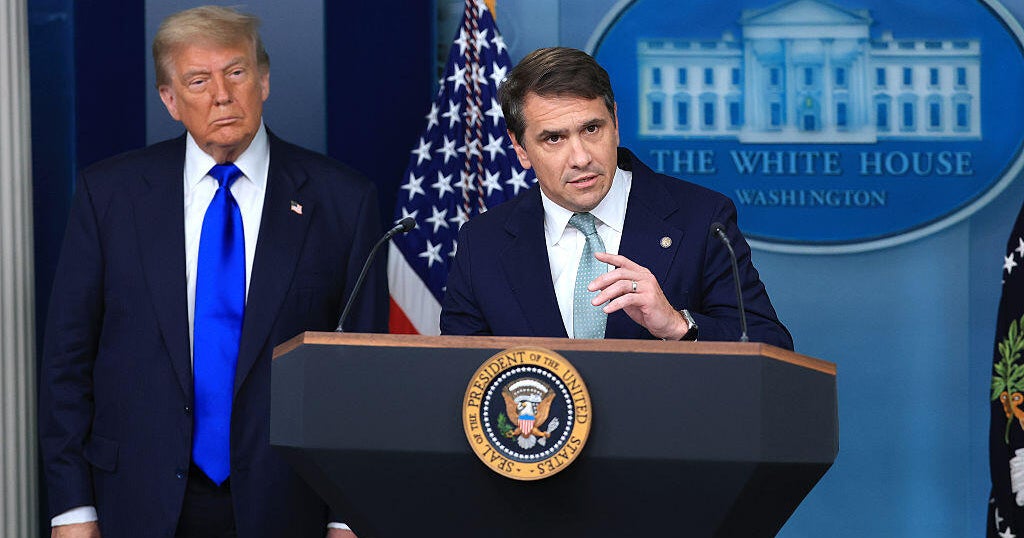
Washington — The Trump administration on Friday declined to submit a declaration in court from Acting Attorney General Todd Blanche and Treasury Secretary Scott Bessent reiterating that the government is not continuing with a controversial $1.8 billion “anti-weaponization” fund, calling a judge’s demand for such a filing “unnecessary.”
In a notice to the federal district court in Alexandria, Virginia, senior Justice Department lawyers rebuffed U.S. District Judge Leonie Brinkema’s request for the declaration from Blanche, Bessent and Associate Attorney General Stanley Woodward.
Brinkema said last week that “to avoid any further litigation,” the senior officials should file the declaration under penalty of perjury that the “anti-weaponization” program wouldn’t proceed “in any manner, or under any name.” She also granted a preliminary injunction that blocks the Justice Department from taking any action to create or operate the program, which remains in place.
The judge warned that if the administration opted not to file the declaration, the lawsuit brought by a coalition that includes two nonprofits and a former federal prosecutor would move forward.
In the notice, Andrew Block, senior counsel to Woodward, said the declaration is “unnecessary and the compelled testimony of senior officials from the Executive Branch implicates serious separation of powers concerns.”
He noted that Blanche had already testified to Congress that the fund is “not going forward, period,” and said similar assertions have been made in court filings from the Justice Department.
“Accordingly, the Court’s demands are unnecessary,” Block wrote. “And its presumption that mootness can arise only by compelling testimony from three senior government officials ‘implicate[s] separation of powers concerns.’ As stated multiple times, the Fund is not moving forward.”
It’s unclear whether Block’s arguments will be enough to persuade Brinkema to agree that the lawsuit should be dropped.
“It is telling that even after the federal court gave them a week, the Acting Attorney General and other senior administration officials continue to refuse to say under oath that the Slush Fund is dead and won’t operate in the future,” Skye Perryman, president and CEO of Democracy Forward, which is representing the plaintiffs, said in a statement. “Nor have they provided any information under oath about their compliance with the court’s prior directives.”
Brinkema gave the Trump administration the chance to clarify the fund’s status following a hearing last week. Block argued before the court that the case should be dismissed because the administration hadn’t set up the fund and isn’t going ahead with it.
While the Justice Department made that assertion in court filings and to Congress during a hearing earlier this month, the judge noted none of those statements were made under penalty of perjury.
The “anti-weaponization” fund was created as part of a deal to settle a civil lawsuit President Trump filed against the Internal Revenue Service in January over the leak of his tax returns by a former government contractor. The $1.776 billion program aimed to “provide a systematic process to hear and redress claims of others who suffered weaponization and lawfare,” the Justice Department said.
But the fund drew serious backlash from Republicans on Capitol Hill, who raised concerns with the possibility that people involved in the Jan. 6, 2021, attack on the U.S. Capitol could receive payouts.
After the “anti-weaponization” program threatened to derail the GOP’s immigration agenda in Congress, Blanche told a House committee that the Justice Department was “not moving forward with the fund.” But he refused to put the commitment in writing, raising the possibility that the fund could be resurrected in another form.
The Justice Department also argued in court papers in two different legal challenges that the program “had not been set up and is now not going forward,” and said the cases are moot and should be dismissed in their entirety. Government lawyers argued that none of the five members who would establish and administer the fund had even been appointed.
But during the hearing before Brinkema last week, the judge expressed skepticism over the Justice Department’s assertion that the fund is dead.
The case before Brinkema was filed by a former prosecutor who worked on cases involving the Jan. 6 attack, as well as the city of New Haven, Connecticut, and two nonprofit groups, Common Cause and the National Abortion Federation.
Other challenges to the fund have been brought in Washington, D.C., and California. In one of the cases in Washington, involving a government watchdog group, a federal judge declined to temporarily halt operation of the fund.