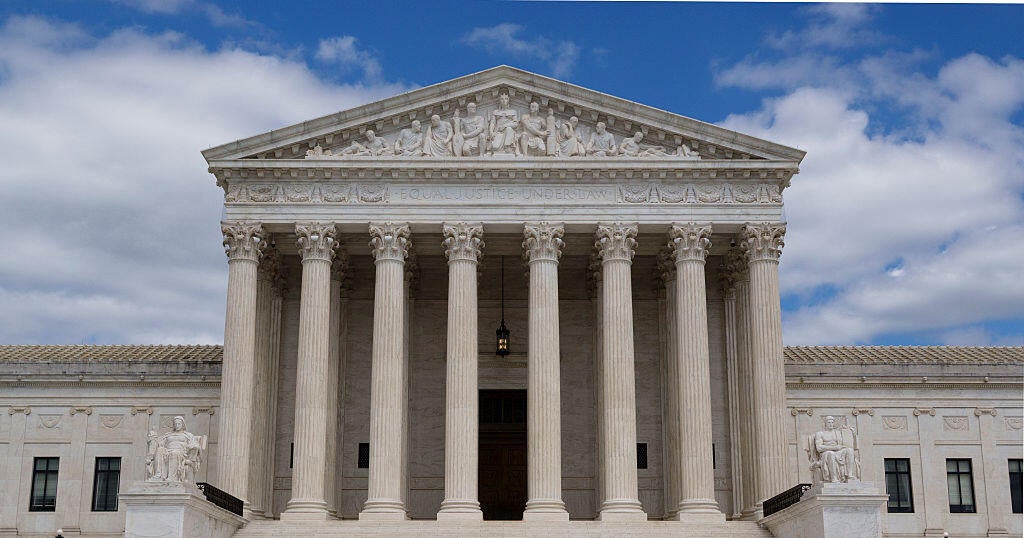
Washington — The Supreme Court on Thursday ruled in favor of a Texas man who challenged a federal law that bars certain drug users from having firearms.
In a unanimous decision in the case U.S. v. Hemani, the justices found that Ali Hemani’s prosecution for having a firearm while he was an unlawful drug user is inconsistent the Second Amendment. Hemani allegedly was only an occasional user of marijuana when the FBI found a handgun at his Texas home in 2022.
The ruling from the Supreme Court is narrow, since the justices did not strike down the law at the center of the case in its entirety. Instead, the high court said the government cannot automatically disarm a person who uses marijuana a few times a week. Justice Neil Gorsuch authored the majority opinion for the court.
The government, he wrote, “asks us to conclude that anyone who regularly uses marijuana is categorically violent and dangerous without any further showing. All based on little more than its current say-so, one at odds with its own regulatory actions. And affording the government that kind of ‘broad power to designate any group as dangerous and thereby disqualify its members from having a gun’ would risk allowing it to ‘quickly swallow’ the Second Amendment.”
The Supreme Court’s decision does not address efforts to ban drug addicts or those presently intoxicated from having firearms, Gorsuch wrote. He also said it does not impact other federal firearms restrictions, including those that disarm convicted felons, or prosecutions that involve proof that a defendant’s drug use renders him dangerous.
The law at issue in the case forbids an unlawful drug user from possessing firearms, and violators face up to 15 years in prison. The Justice Department estimates roughly 300 people are charged with the offense each year.
Perhaps the most high-profile person convicted under the law was Hunter Biden, former President Joe Biden’s son, though he was pardoned by his father in December 2024.
The law at the center of the case was the latest to face Supreme Court scrutiny in the wake of its landmark 2022 decision that recognized the right to carry a firearm outside the home. In that decision, the high court laid out a new test for courts to apply when considering the constitution of a gun law. The framework requires the government to show that a restriction is consistent with the nation’s historical tradition of firearms regulation.
In the wake of that ruling, the Supreme Court upheld in 2024 a federal law barring people subject to domestic violence restraining orders from having guns. The justices are also considering a challenge to a Hawaii law that prohibits people with concealed carry permits from bringing their guns onto private property open to the public without permission.
The government’s case against Hemani focused solely on his marijuana use, which his lawyers said did not make him dangerous. Forty states have legalized marijuana use to some degree in recent years, adding a wrinkle to the legal battle. While it remains illegal at the federal level, President Trump signed an executive order in December to reschedule marijuana to a lower drug classification. The Justice Department in April rescheduled certain marijuana products to a lower drug classification.
Gorsuch, in the majority opinion, and Justice Samuel Alito, in a concurring opinion joined by Justice Elena Kagan, both noted the shifts in marijuana policy at the federal and state levels, as well as the rise in marijuana consumption, and said those trends worked against the Justice Department in the case.
“Whatever one thinks of these developments, the federal government has not just tolerated them; it helped fuel them,” Gorsuch wrote. “All of which leaves it awkwardly positioned to suggest that the millions of Americans who now regularly use marijuana are categorically and unusually dangerous. “
While the president has taken steps to bolster Second Amendment rights, the Trump administration also defended the ban on possession by drug users before the Supreme Court and urged it to uphold the restriction.
In filings with the high court, the Justice Department said the Second Amendment allows Congress to restrict gun possession by habitual drug users. Backing the Trump administration were gun violence prevention groups like the Brady Center for Prevent Gun Violence and Giffords Law Center to Prevent Gun Violence.
But on the other side, the American Civil Liberties Union signed on as co-counsel to represent Hemani. Also backing him were gun rights groups like the National Rifle Association.
The ACLU cheered the Supreme Court’s decision rejecting Hemani’s prosecution, saying it makes it clear that the government cannot make it a crime for people who use marijuana to own a gun.
“With nearly half of Americans reporting marijuana use at some point in their lives, this ruling protects the rights of millions and curbs the government’s ability to impose arbitrary and discriminatory penalties,” Cecillia Wang, the ACLU’s legal director, said in a statement. “The court has sent a strong message that the government cannot criminalize the conduct of large numbers of people by making categorical and unfounded assumptions about whether they are dangerous.”