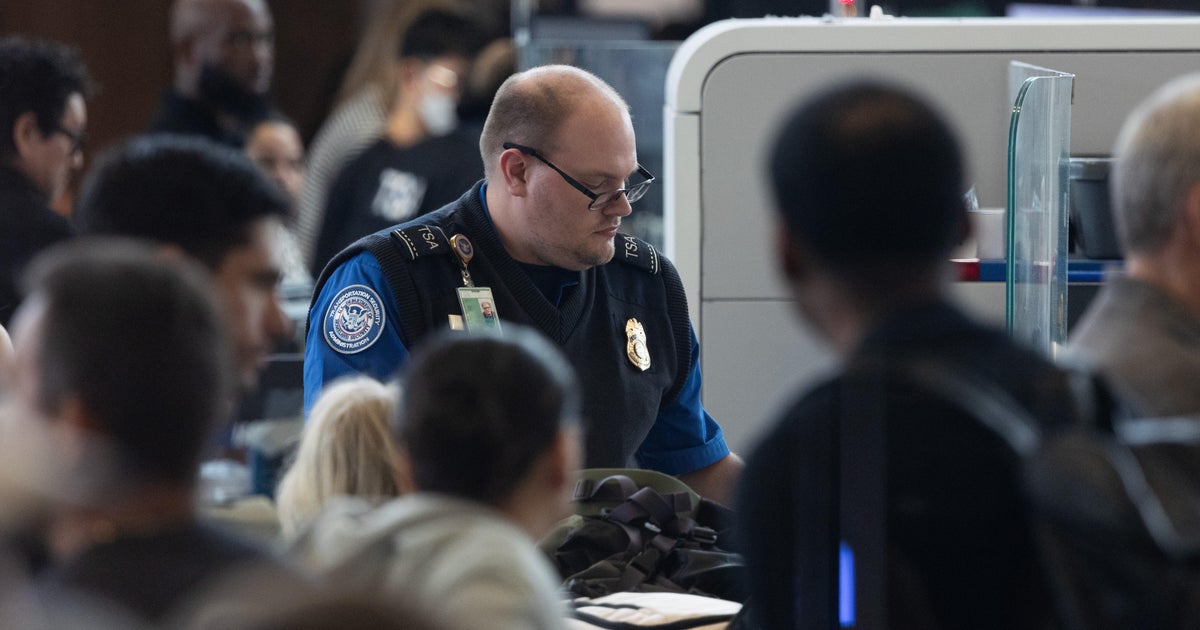
The Tampa, Charleston and Des Moines airports have signed on to a new program to privatize airport security, the Transportation Security Administration told CBS News.
Under the new initiative, called TSA Gold+, TSA would maintain oversight of security standards and operations but would use private contractors for screening instead of federal workers.
Gold+ is an expansion of the Screening Partnership Program (SPP), which similarly allows airports to hire private contractors to conduct security screening under federal oversight. Launched in 2004 by the TSA, the program operates at 20 airports across the U.S., including San Francisco International Airport and Kansas City International Airport.
“The new TSA Gold+ program mostly expands on what those contractors are allowed to manage, including the actual screening technology,” said Julian Kheel, founder of travel rewards site Points Path.
In an email seen by CBS News from the TSA to the American Federation of Government Employees (AFGE), a union that represents airport employees, the agency listed January 2027 as the projected launch period for Gold+ at the Des Moines airport, February 2027 for Charleston and May 2027 for Tampa.
The email also mentions briefings the agency held at the participating airports to discuss the Gold+ program and its potential impact on employees at Tampa, Des Moines and Charleston airports.
“TSA Gold+ presents a new way for airports to deliver exceptional service to every traveler, while advancing security, efficiency, and the overall airport experience,” a TSA spokesperson said in an email to CBS News. “Throughout the transition of these airports, we remain committed to operational stability and supporting our employees.”
TSA did not respond to a request for comment from CBS News about its process for selecting private screening contractors.
On its Gold+ website, the agency claims that introducing new screening technology through the program will expedite screening and enhance security.
“Private investment allows airports to adopt innovative solutions more quickly, improving both safety and the passenger experience,” the agency’s Gold+ website says.
Security, workforce concerns
The Gold+ program has ignited backlash from AFGE, which represents 47,000 transportation security officers across 400 U.S. airports. In a statement shared with CBS News, the union said that the Gold+ measure would jeopardize public safety by removing TSA workers from the screening process.
The union’s national president Everett Kelley called it a “major departure and step backward” from the screening systems that Congress created after the 9/11 attacks.
“Changes of this magnitude should not be made behind closed doors without the input of Congress, the flying public, the local airport authorities and TSA employees themselves,” he said.
In November 2001, Congress passed the Aviation and Transportation Security Act, which established the TSA as the agency responsible for overseeing airport security. Prior to its passage, air carriers were responsible for airport screening, a task that most contracted out to private companies, the Government Accountability Office said in a 2005 report.
Kheel said the safety questions surrounding Gold+ aren’t just about private versus public security, but are also about the TSA’s role in setting and evaluating its own safety standards.
“The TSA has effectively been grading its own homework for the two decades since it both writes the standards and staffs the checkpoints,” he said. “That dual role isn’t ideal, regardless of whether airports are utilizing government or private screeners.”
AFGE also expressed concerns that the Gold+ program will lead to workforce cuts for airport employees. The union pointed to the administration’s fiscal 2027 budget for the agency, which includes plans to cut nearly 8,400 workers, including 2,462 transportation security officer (TSO) positions. About half of those would be replaced through the expansion of TSA’s privatization efforts, the union said.
“The administration’s actions should concern all Americans, and AFGE will continue to speak out against any proposal that threatens our members’ jobs and jeopardizes the safety of the flying public,” Kelley said.