President Trump said in a Truth Social post on June 11 that the United States would “be taking Kharg Island” and other key Iranian oil infrastructure “in the not too distant future,” as the war between the two countries, launched jointly by the U.S. and Israel on Feb. 28, appeared to reignite.
He told Fox News shortly after that he wasn’t sure “America has the appetite” for an operation to seize the Iranian island, a strategic patch of ground that has been a recurring focus of the two countries’ war for months.
The U.S. military previously said strikes on March 13 had “totally obliterated” every military target on Kharg Island, thrusting the small isle into the global spotlight. Just 20 miles off Iran’s northern Gulf coast, Kharg is a hub for Iranian oil exports, and Mr. Trump had signaled early in the war that the U.S. could try to use it as a bargaining chip to force Iran to drop its threats to the Strait of Hormuz and Persian Gulf states.
President Trump warned in his June 11 social media post that the U.S. would hit Iran “very hard” immediately, and seize more of its infrastructure in the coming days.
Here’s what to know about Kharg Island, and why it is strategically valuable.
What is Kharg Island?
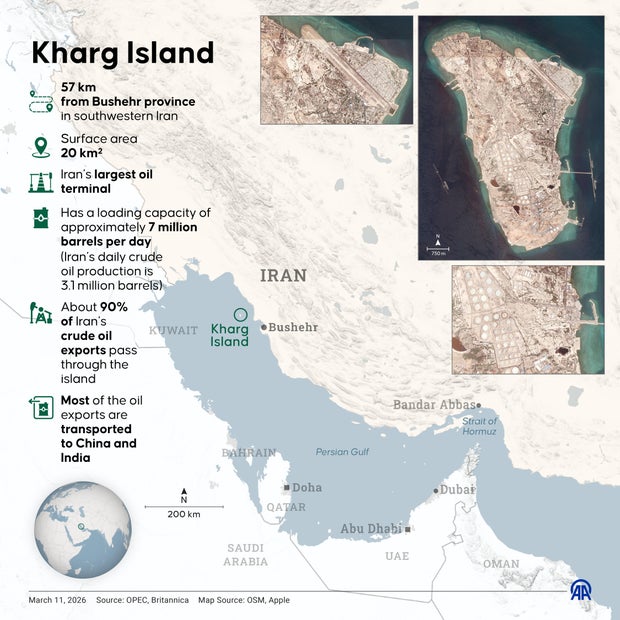
Kharg Island lies roughly 20 miles off Iran’s northern Gulf coast. For decades, it has served as Iran’s main oil export terminal, historically handling 85–95% of the country’s crude exports.
Elif Acar/Anadolu/Getty 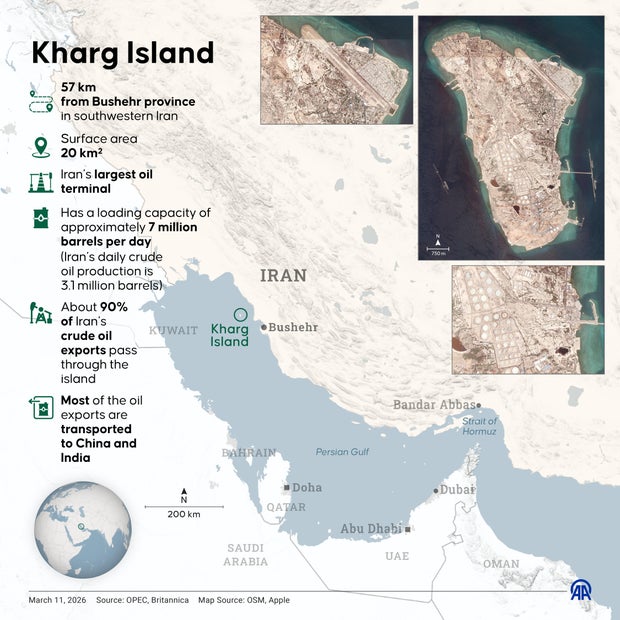
Tankers load up on the island before heading through the Persian Gulf and the Strait of Hormuz. If the island’s loading facilities were knocked out, Iran’s ability to export oil would collapse almost immediately. Oil revenue, earned mainly by selling crude to China, remains one of the Islamic Republic’s most important sources of funding.
Strikes on Iran’s oil infrastructure could send global oil prices — which have been up around 30% since the war began — even higher.
How could strikes threaten Iran’s energy system?
Iran’s attacks on shipping and Gulf states have severely limited traffic through the Strait of Hormuz, but the strikes on Kharg Island in March, and the threat of new ones, show the U.S. can at least try to hit Iran’s finances.
National security analyst Aaron MacLean told “CBS Saturday Morning” that Mr. Trump has shown he has leverage if Iran continues threatening the key shipping lanes. About 20% of the world’s oil supplies typically passed through the strait before the war.
“The president has linked the vulnerability of Kharg Island to Iran’s continued closure of the Strait of Hormuz,” MacLean said in March.
Kharg Island has been a target before
This isn’t the first time Kharg Island has been at the center of a war. During the Iran-Iraq War in the 1980s, Saddam Hussein sent Iraqi aircraft to repeatedly bomb the island in an attempt to choke off Iran’s oil revenue. The facilities were badly damaged, but Iran kept repairing them and exports continued.
Since then, Tehran had fortified Kharg heavily, building air defenses, hardened infrastructure and underground storage designed to keep oil flowing even under sustained attack.
While Iran cannot match the United States or Israel in conventional military terms, it has spent decades preparing for asymmetric war.
If Kharg Island were seriously threatened, Tehran would likely respond across multiple fronts. Iran’s military could continue to strike U.S. bases across the Gulf, increase attacks by allied militias in Iraq and elsewhere, and keep striking vessels in the Strait of Hormuz using fast attack boats, naval mines and suicide drones.
Iran’s Houthi allies in Yemen have also threatened to attack shipping through another key Middle East waterway, the Bab el-Mandeb strait.
On June 1, an Iranian news outlet closely linked with the country’s Islamic Revolutionary Guard Corps indicated that the Iranian regime had given the Houthis a nod to start attacking commercial vessels, announcing “the activation of other fronts, including the Bab el-Mandeb Strait.”